参悟Python设计思想03 | 从集合处理API,看Python多层API架构
## 关键认知 🌞 从 C 语言开始,编程语言的 API 就有标准库、三方库之分。如下图所示。 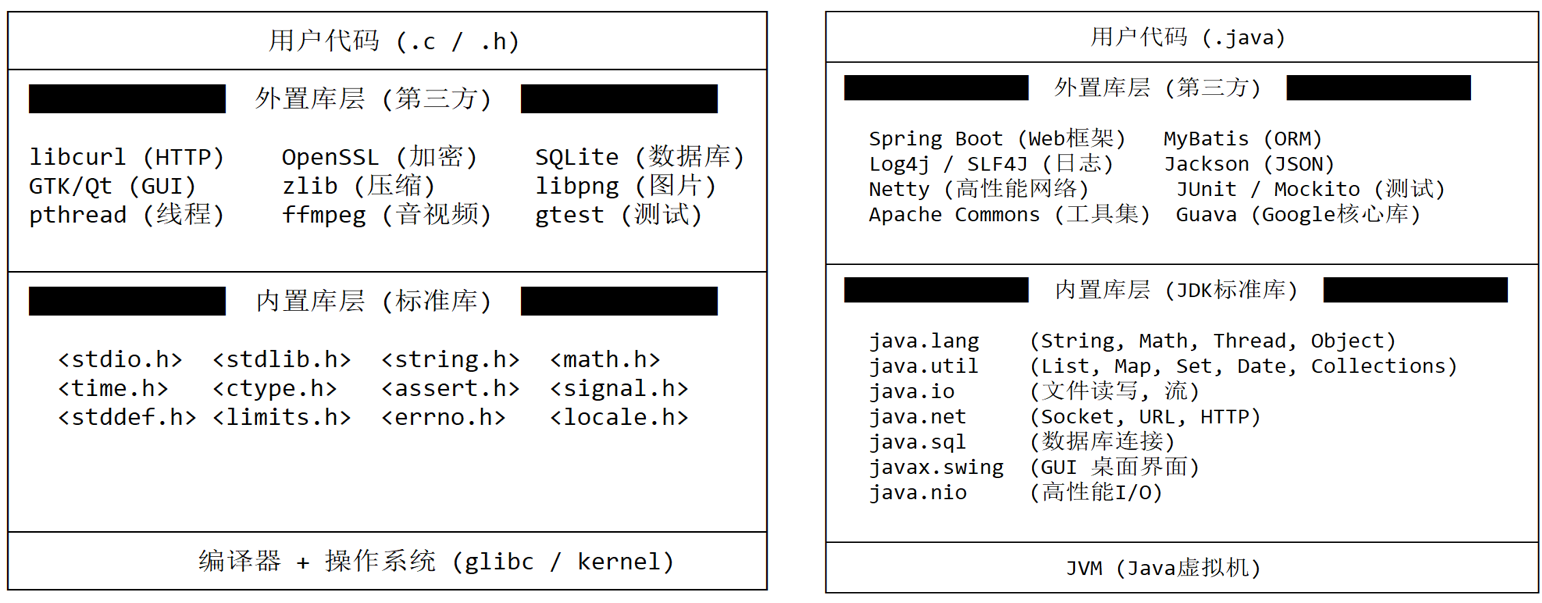 ⚡ Python 还多一层 “ 解释器实现的bultins函数 ”。你找CPython源码,一看便知。 💎 Python作为一门面向数据科学和通用编程的语言,其内置的集合数据类型——列表(list)、字典(dict)、集合(set)和元组(tuple)——为开发者提供了灵活而强大的数据组织方式。 💎 然而,原始的数据处理往往伴随着冗长的循环语句和繁琐的条件判断。为了大幅提升开发效率和代码可读性,Python社区和语言设计者推出了多类设计举措,从数据结构本身到语法糖再到标准库函数,全面简化了集合数据的操作流程。 💎 本文将围绕"6类30项设计"这一框架,系统梳理Python在简化集合数据处理方面的核心工具与方法。其中,第一类和第二类属于**数据结构层面**的设计举措,第三至第六类属于**操作工具层面**的设计举措。看文尾总结。 💎 本文将围绕"6类30项设计"这一框架,这 6 类设计分别对应【内置函数层】、【内置库层】。看图。 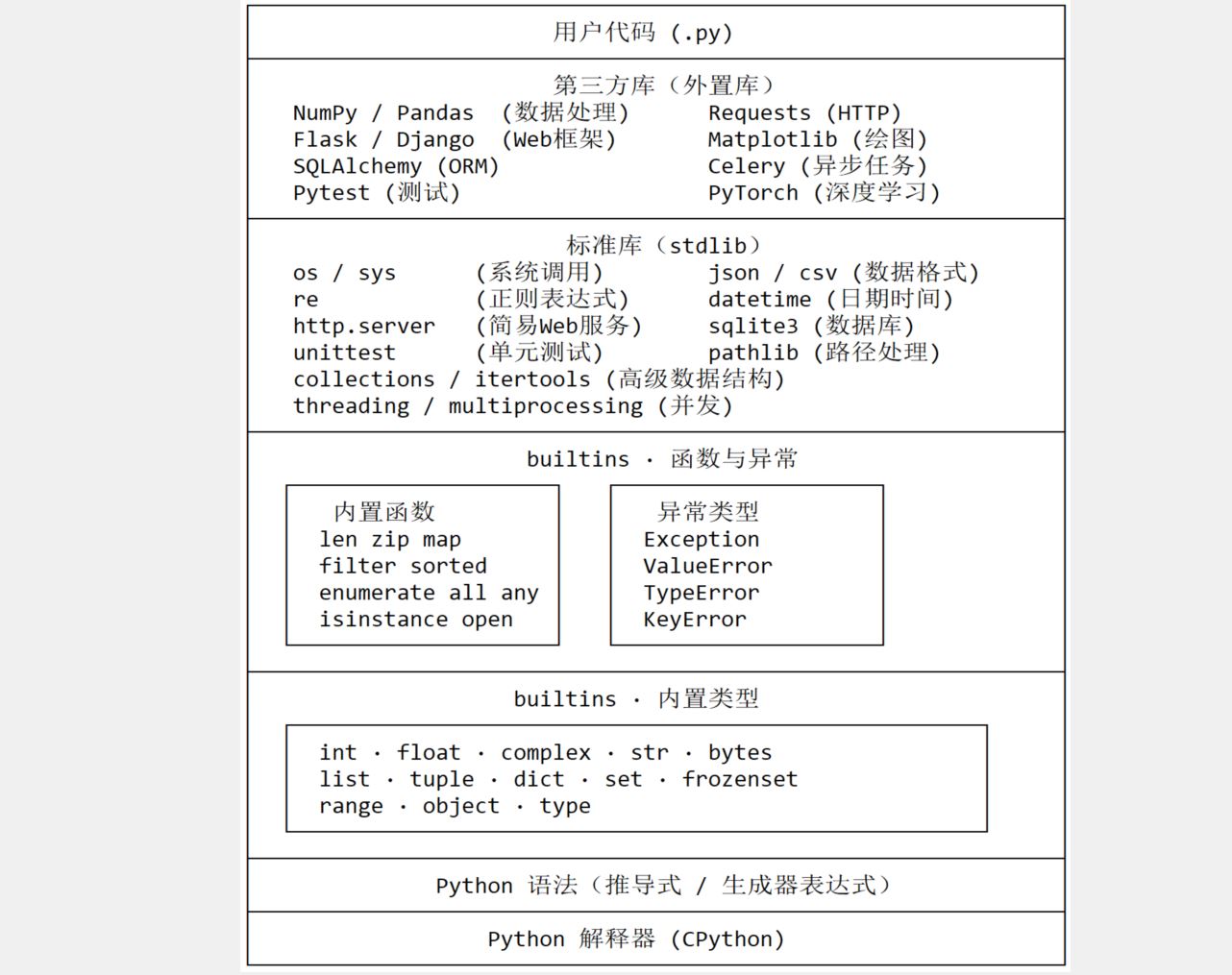 --- ## 第一类设计:四大内置集合数据类型(4项) Python内置的四种集合数据类型是最基本、最核心的设计举措。它们是所有后续操作的基础载体,每一种都针对特定的使用场景进行了设计优化。 ### 1. 列表(list)—— 有序可变序列 支持索引访问、切片操作、动态增删改查。适用于需要保持元素顺序且频繁修改的场景。 ```python lst = [1, 2, 3] lst.append(4) # 尾部追加 lst.insert(0, 0) # 指定位置插入 lst.pop() # 尾部弹出 ``` ### 2. 字典(dict)—— 键值映射表 基于哈希表实现,查找效率为O(1)。适用于需要通过唯一键快速检索值的场景。 ```python d = {'name': 'Alice', 'age': 25} d['city'] = 'Shanghai' # 新增键值对 d.get('phone', 'N/A') # 安全取值 ``` ### 3. 集合(set)—— 无序唯一集 自动去重,支持数学集合运算(交集、并集、差集等)。适用于成员检测和去重场景。 ```python s1 = {1, 2, 3} s2 = {2, 3, 4} s1 & s2 # 交集 {2, 3} s1 | s2 # 并集 {1, 2, 3, 4} ``` ### 4. 元组(tuple)—— 不可变序列 一旦创建不可修改,可作为字典的键或集合的元素。适用于表示固定结构的数据记录。 ```python t = (1, 2, 3) a, b, c = t # 解包赋值 ``` --- ## 第二类设计:collections模块六大专用容器(6项) `collections`模块扩展了Python的内置集合类型,针对特定场景提供了优化容器。这是对第一类设计的重要补充。 ### 1. namedtuple —— 具名元组 为元组中的每个字段赋予名称,兼具元组的轻量和类的可读性: ```python from collections import namedtuple Point = namedtuple('Point', ['x', 'y']) p = Point(10, 20) print(p.x, p.y) # 10 20 ``` ### 2. deque —— 双端队列 两端均可高效增删元素,时间复杂度均为O(1): ```python from collections import deque dq = deque([1, 2, 3]) dq.appendleft(0) # 左侧添加 dq.append(4) # 右侧添加 dq.popleft() # 左侧弹出 ``` ### 3. Counter —— 计数器 自动统计元素出现次数,支持most_common()方法: ```python from collections import Counter cnt = Counter('abracadabra') cnt.most_common(3) # [('a', 5), ('b', 2), ('r', 2)] ``` ### 4. OrderedDict —— 有序字典 保持键值对的插入顺序(Python 3.7+后普通dict已有此特性,但OrderedDict额外支持reorder操作): ```python from collections import OrderedDict od = OrderedDict() od['a'] = 1 od['b'] = 2 od.move_to_end('a') # 将'a'移到末尾 ``` ### 5. defaultdict —— 自动默认值字典 访问不存在的键时自动调用工厂函数创建默认值,彻底消除KeyError: ```python from collections import defaultdict dd = defaultdict(list) dd['group1'].append(1) # 无需先初始化空列表 dd['group1'].append(2) # dd变为{'group1': [1, 2]} ``` ### 6. ChainMap —— 链式映射 将多个字典合并为单一视图,查找时按顺序遍历各字典: ```python from collections import ChainMap d1 = {'a': 1, 'b': 2} d2 = {'b': 3, 'c': 4} cm = ChainMap(d1, d2) cm['b'] # 返回1(来自d1),遵循优先级 ``` --- ## 第三类设计:Comprehension四大推导式(4项) 推导式(Comprehension)是Python最具标志性的语法糖之一,它用一行表达式替代了传统的for循环+条件判断模式。 ### 1. 列表推导式(List Comprehension) ```python squares = [x**2 for x in range(10) if x % 2 == 0] ``` 等价于: ```python squares = [] for x in range(10): if x % 2 == 0: squares.append(x**2) ``` ### 2. 字典推导式(Dict Comprehension) ```python square_dict = {x: x**2 for x in range(5)} ``` ### 3. 集合推导式(Set Comprehension) ```python unique_squares = {x**2 for x in [-2, -1, 0, 1, 2]} ``` ### 4. 生成器表达式(Generator Expression) ```python sum_of_squares = sum(x**2 for x in range(1000000)) ``` ### 5. 实际案例:带订单ID的业务报告 ```python def check_order_qualification(order): """返回订单是否达标的判定结果(含订单ID)""" return { 'order_id': order['order_id'], 'qualified': order['amount'] > 100, 'reason': '达标' if order['amount'] > 100 else '金额不足' } def is_active_order(status_code): """有效订单:状态码1=待支付,2=已支付,3=配送中""" return status_code in [1, 2, 3] orders = [ {'order_id': 'A001', 'amount': 88, 'status': 1}, {'order_id': 'A002', 'amount': 220, 'status': 2}, {'order_id': 'A003', 'amount': 500, 'status': 0}, # 已取消 {'order_id': 'A004', 'amount': 175, 'status': 3}, {'order_id': 'A005', 'amount': 999, 'status': 4}, # 已完成(已归档) ] report = [ check_order_qualification(order) for order in orders if is_active_order(order['status']) ] print(report) # 输出: # [ # {'order_id': 'A001', 'qualified': False, 'reason': '金额不足'}, # {'order_id': 'A002', 'qualified': True, 'reason': '达标'}, # {'order_id': 'A004', 'qualified': True, 'reason': '达标'} # ] ``` --- ## 第四类设计:三大高阶函数(3项) Python内置了三个经典的高阶函数,用于替代显式循环,实现函数式编程风格。 ### 1. map() —— 映射变换 对可迭代对象中的每个元素应用指定的函数: ```python list(map(str.upper, ["hello", "world"])) # ['HELLO', 'WORLD'] ``` ### 2. filter() —— 条件筛选 根据布尔函数过滤可迭代对象中的元素: ```python list(filter(lambda x: x > 0, [-2, -1, 0, 1, 2])) # [1, 2] ``` ### 3. reduce() —— 累积归约 对可迭代对象中的元素进行累积运算(需从functools导入): ```python from functools import reduce reduce(lambda a, b: a * b, [1, 2, 3, 4]) # 24 ``` ### 4. 实际案例:用 `map()` 和生成器表达式替代 `lambda` + `filter()` **Google Python 规范不推荐 (使用 lambda 和 filter)** ```python numbers = [1, 2, 3, 4, 5, 6] # 过滤出偶数 even_numbers = list(filter(lambda x: x % 2 == 0, numbers)) print(even_numbers) # 输出: [2, 4, 6] ``` **推荐 (使用生成器表达式)** ```python numbers = [1, 2, 3, 4, 5, 6] # 使用生成器表达式,更清晰 even_numbers = [x for x in numbers if x % 2 == 0] print(even_numbers) # 输出: [2, 4, 6] ``` --- ## 第五类设计:itertools模块八大迭代器工具(8项) `itertools`是Python标准库中最强大的集合数据处理模块之一,提供了一系列高效的迭代器工具。 ### 无限迭代器(3项) 1. **count(start, step)** —— 无限递增计数器 ```python from itertools import count for i in count(10, 2): # 10, 12, 14, ... if i > 20: break ``` 2. **cycle(iterable)** —— 无限循环重复 ```python from itertools import cycle for item in cycle(['A', 'B', 'C']): # A, B, C, A, B, C, ... pass ``` 3. **repeat(object, times)** —— 重复生成同一对象 ```python from itertools import repeat list(repeat('x', 3)) # ['x', 'x', 'x'] ``` ### 组合迭代器(3项) 4. **product(*iterables)** —— 笛卡尔积 ```python list(product([1,2], ['a','b'])) # [(1,'a'), (1,'b'), (2,'a'), (2,'b')] ``` 5. **permutations(iterable, r)** —— 排列 ```python list(permutations([1,2,3], 2)) # [(1,2), (1,3), (2,1), (2,3), (3,1), (3,2)] ``` 6. **combinations(iterable, r)** —— 组合 ```python list(combinations([1,2,3], 2)) # [(1,2), (1,3), (2,3)] ``` ### 分组与合并(2项) 7. **groupby(iterable, key)** —— 连续元素分组 ```python data = [('A',1), ('A',2), ('B',3)] for key, group in groupby(data, lambda x: x[0]): print(key, list(group)) ``` 8. **chain(*iterables)** —— 链式合并 ```python list(chain([1,2], [3,4], [5,6])) # [1,2,3,4,5,6] ``` --- ## 第六类设计:五大内置函数与运算符(5项) Python还通过内置函数和`operator`模块进一步简化集合操作。 ### 1. sorted() —— 灵活排序 支持key参数自定义排序规则,无需手写排序算法: ```python students = [{'name':'Alice','grade':88}, {'name':'Bob','grade':95}] sorted(students, key=lambda s: s['grade'], reverse=True) ``` ### 2. enumerate() —— 带索引遍历 同时获取索引和元素,彻底替代range(len())模式: ```python for i, val in enumerate(['a','b','c'], start=1): print(i, val) ``` ### 3. zip() —— 并行打包 将多个可迭代对象按位置配对,常用于矩阵转置或字段对齐: ```python names = ['Alice', 'Bob'] scores = [88, 95] list(zip(names, scores)) # [('Alice',88), ('Bob',95)] ``` ### 4. any() / all() —— 逻辑判定 快速判断集合中是否存在满足条件的元素: ```python nums = [1, 2, 3, -1] any(x 0 for x in nums) # False(并非全部为正) ``` ### 5. operator.itemgetter() —— 字段提取器 配合sorted()、map()等函数使用,提取字典或对象的指定字段: ```python from operator import itemgetter students = [{'name':'Alice','grade':88}, {'name':'Bob','grade':95}] sorted(students, key=itemgetter('grade')) # 按成绩升序排序 ``` --- ## 总结:6类30项设计总览 综合以上分析,我们给出完整的分类统计表: | 类别层级 | 类别名称 | 设计数量 | 具体设计 | |----------|----------|----------|----------| | **数据结构层面** | 内置集合数据类型 | 4项 | list、dict、set、tuple | | | collections专用容器 | 6项 | namedtuple、deque、Counter、OrderedDict、defaultdict、ChainMap | | **操作工具层面** | Comprehension推导式 | 4项 | 列表推导式、字典推导式、集合推导式、生成器表达式 | | | 高阶函数 | 3项 | map()、filter()、reduce() | | | itertools迭代器工具 | 8项 | count、cycle、repeat、product、permutations、combinations、groupby、chain | | | 内置函数与运算符 | 5项 | sorted()、enumerate()、zip()、any()/all()、operator.itemgetter() | **总计:6大类,30项设计** 这30项设计共同构成了Python简化集合数据处理的完整工具箱。它们的设计哲学高度一致: - **数据结构层面**:第一类和第二类提供了丰富多样的数据组织方式,让开发者能够选择最适合业务场景的容器; - **操作工具层面**:第三至第六类提供了声明式、函数式和管道式的数据处理手段,让代码更加简洁、可读、可维护。 正是这两大层面的有机结合,让Python在处理列表、字典、集合等数据类型时,既能保持代码的简洁优雅,又不失性能与灵活性。对于任何希望写出Pythonic代码的开发者而言,熟练掌握这6类30项工具,将是通往高效数据处理之路的关键一步。