-
单条记录的随机查找
-
aggregation聚合并且sorting后输出
使用以下Spark的三种方式来解决上面的2个问题,对比性能。
-
Using RDD’s
-
Using DataFrames
-
Using SparkSQL
数据源
-
在HDFS中3个文件中存储的9百万不同记录
- 每条记录11个字段
-
总大小 1.4 GB
实验环境
-
HDP 2.4
-
Hadoop version 2.7
-
Spark 1.6
-
HDP Sandbox
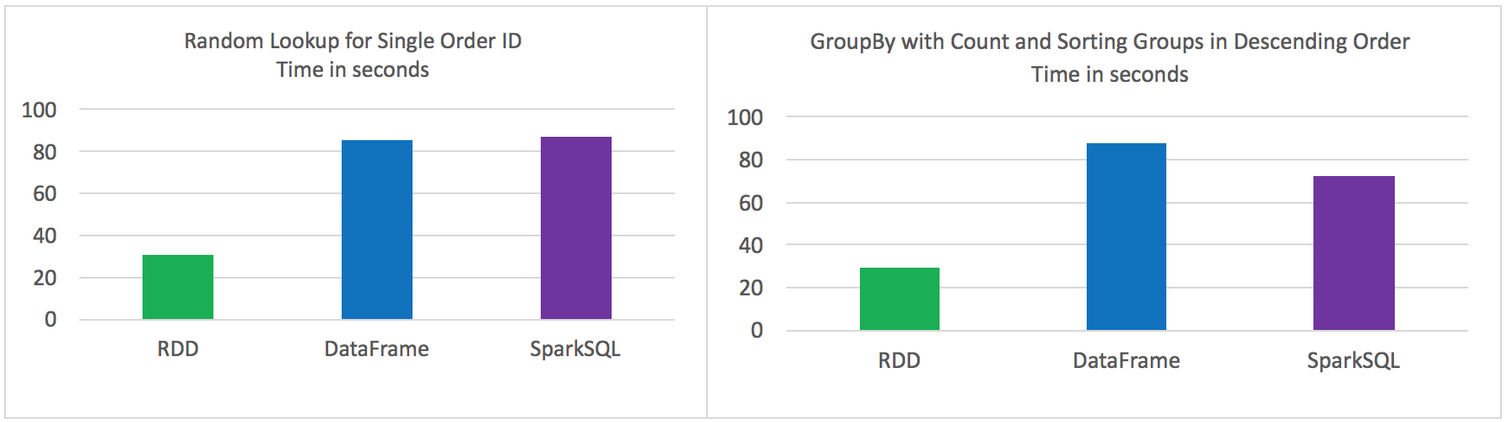
测试结果
-
原始的RDD 比 DataFrames 和 SparkSQL性能要好
-
DataFrames 和 SparkSQL 性能差不多
-
使用DataFrames 和 SparkSQL 比 RDD 操作更直观
-
Jobs都是独立运行,没有其他job的干扰
2个操作
-
Random lookup against 1 order ID from 9 Million unique order ID's
-
GROUP all the different products with their total COUNTS and SORT DESCENDING by product name
![]()
代码
RDD Random Lookup
#!/usr/bin/env python

from time import time
from pyspark import SparkConf, SparkContext

conf = (SparkConf()
  .setAppName("rdd_random_lookup")
  .set("spark.executor.instances", "10")
  .set("spark.executor.cores", 2)
  .set("spark.dynamicAllocation.enabled", "false")
  .set("spark.shuffle.service.enabled", "false")
  .set("spark.executor.memory", "500MB"))
sc = SparkContext(conf = conf)

t0 = time()

path = "/data/customer_orders*"
lines = sc.textFile(path)

## filter where the order_id, the second field, is equal to 96922894
print lines.map(lambda line: line.split('|')).filter(lambda line: int(line[1]) == 96922894).collect()

tt = str(time() - t0)
print "RDD lookup performed in " + tt + " seconds"
DataFrame Random Lookup
![复制代码]()
#!/usr/bin/env python

from time import time
from pyspark.sql import *
from pyspark import SparkConf, SparkContext

conf = (SparkConf()
  .setAppName("data_frame_random_lookup")
  .set("spark.executor.instances", "10")
  .set("spark.executor.cores", 2)
  .set("spark.dynamicAllocation.enabled", "false")
  .set("spark.shuffle.service.enabled", "false")
  .set("spark.executor.memory", "500MB"))
sc = SparkContext(conf = conf)

sqlContext = SQLContext(sc)

t0 = time()

path = "/data/customer_orders*"
lines = sc.textFile(path)

## create data frame
orders_df = sqlContext.createDataFrame( \
lines.map(lambda l: l.split("|")) \
.map(lambda p: Row(cust_id=int(p[0]), order_id=int(p[1]), email_hash=p[2], ssn_hash=p[3], product_id=int(p[4]), product_desc=p[5], \
country=p[6], state=p[7], shipping_carrier=p[8], shipping_type=p[9], shipping_class=p[10]  ) ) )

## filter where the order_id, the second field, is equal to 96922894
orders_df.where(orders_df['order_id'] == 96922894).show()

tt = str(time() - t0)
print "DataFrame performed in " + tt + " seconds"
![复制代码]()
SparkSQL Random Lookup
![复制代码]()
#!/usr/bin/env python

from time import time
from pyspark.sql import *
from pyspark import SparkConf, SparkContext

conf = (SparkConf()
  .setAppName("spark_sql_random_lookup")
  .set("spark.executor.instances", "10")
  .set("spark.executor.cores", 2)
  .set("spark.dynamicAllocation.enabled", "false")
  .set("spark.shuffle.service.enabled", "false")
  .set("spark.executor.memory", "500MB"))
sc = SparkContext(conf = conf)

sqlContext = SQLContext(sc)

t0 = time()

path = "/data/customer_orders*"
lines = sc.textFile(path)

## create data frame
orders_df = sqlContext.createDataFrame( \
lines.map(lambda l: l.split("|")) \
.map(lambda p: Row(cust_id=int(p[0]), order_id=int(p[1]), email_hash=p[2], ssn_hash=p[3], product_id=int(p[4]), product_desc=p[5], \
country=p[6], state=p[7], shipping_carrier=p[8], shipping_type=p[9], shipping_class=p[10]  ) ) )

## register data frame as a temporary table
orders_df.registerTempTable("orders")

## filter where the customer_id, the first field, is equal to 96922894
print sqlContext.sql("SELECT * FROM orders where order_id = 96922894").collect()

tt = str(time() - t0)
print "SparkSQL performed in " + tt + " seconds"
![复制代码]()
RDD with GroupBy, Count, and Sort Descending
#!/usr/bin/env python

from time import time
from pyspark import SparkConf, SparkContext

conf = (SparkConf()
  .setAppName("rdd_aggregation_and_sort")
  .set("spark.executor.instances", "10")
  .set("spark.executor.cores", 2)
  .set("spark.dynamicAllocation.enabled", "false")
  .set("spark.shuffle.service.enabled", "false")
  .set("spark.executor.memory", "500MB"))
sc = SparkContext(conf = conf)

t0 = time()

path = "/data/customer_orders*"
lines = sc.textFile(path)

counts = lines.map(lambda line: line.split('|')) \
.map(lambda x: (x[5], 1)) \
.reduceByKey(lambda a, b: a + b) \
.map(lambda x:(x[1],x[0])) \
.sortByKey(ascending=False)

for x in counts.collect():
  print x[1] + '\t' + str(x[0])

tt = str(time() - t0)
print "RDD GroupBy performed in " + tt + " seconds"
DataFrame with GroupBy, Count, and Sort Descending
![复制代码]()
#!/usr/bin/env python

from time import time
from pyspark.sql import *
from pyspark import SparkConf, SparkContext

conf = (SparkConf()
  .setAppName("data_frame_aggregation_and_sort")
  .set("spark.executor.instances", "10")
  .set("spark.executor.cores", 2)
  .set("spark.dynamicAllocation.enabled", "false")
  .set("spark.shuffle.service.enabled", "false")
  .set("spark.executor.memory", "500MB"))
sc = SparkContext(conf = conf)

sqlContext = SQLContext(sc)

t0 = time()

path = "/data/customer_orders*"
lines = sc.textFile(path)

## create data frame
orders_df = sqlContext.createDataFrame( \
lines.map(lambda l: l.split("|")) \
.map(lambda p: Row(cust_id=int(p[0]), order_id=int(p[1]), email_hash=p[2], ssn_hash=p[3], product_id=int(p[4]), product_desc=p[5], \
country=p[6], state=p[7], shipping_carrier=p[8], shipping_type=p[9], shipping_class=p[10]  ) ) )

results = orders_df.groupBy(orders_df['product_desc']).count().sort("count",ascending=False)

for x in results.collect():
  print x

tt = str(time() - t0)
print "DataFrame performed in " + tt + " seconds"
![复制代码]()
SparkSQL with GroupBy, Count, and Sort Descending
#!/usr/bin/env python

from time import time
from pyspark.sql import *
from pyspark import SparkConf, SparkContext

conf = (SparkConf()
  .setAppName("spark_sql_aggregation_and_sort")
  .set("spark.executor.instances", "10")
  .set("spark.executor.cores", 2)
  .set("spark.dynamicAllocation.enabled", "false")
  .set("spark.shuffle.service.enabled", "false")
  .set("spark.executor.memory", "500MB"))
sc = SparkContext(conf = conf)

sqlContext = SQLContext(sc)

t0 = time()

path = "/data/customer_orders*"
lines = sc.textFile(path)

## create data frame
orders_df = sqlContext.createDataFrame(lines.map(lambda l: l.split("|")) \
.map(lambda r: Row(product=r[5])))

## register data frame as a temporary table
orders_df.registerTempTable("orders")

results = sqlContext.sql("SELECT product, count(*) AS total_count FROM orders GROUP BY product ORDER BY total_count DESC")

for x in results.collect():
  print x

tt = str(time() - t0)
print "SparkSQL performed in " + tt + " seconds"