首页 文章 精选 留言 我的

精选列表

搜索[Java],共10000篇文章
优秀的个人博客,低调大师

Java并发编程实战系列10之避免活跃性危险

10.1 死锁 哲学家问题 有环 A等B,B等A 数据库往往可以检测和解决死锁//TODO JVM不行,一旦死锁只有停止重启。 下面分别介绍了几种典型的死锁情况: 10.1.1 Lock ordering Deadlocks 下面是一个经典的锁顺序死锁:两个线程用不同的顺序来获得相同的锁,如果按照锁的请求顺序来请求锁,就不会发生这种循环依赖的情况。 public class LeftRightDeadlock { private final Object left = new Object(); private final Object right = new Object(); public void leftRight() { synchronized (left) { synchronized (right) { doSomething(); } } } public void rightLeft() { synchronized (right) { synchronized (left) { doSomethingElse(); } } } void doSomething() { } void doSomethingElse() { } } 10.1.1 Dynamic Lock Order Deadlocks 下面的转账例子,如果一个线程X向Y转,而另外一个线程Y向X也转,那么就会发生死锁。 public class DynamicOrderDeadlock { // Warning: deadlock-prone! public static void transferMoney(Account fromAccount, Account toAccount, DollarAmount amount) throws InsufficientFundsException { synchronized (fromAccount) { synchronized (toAccount) { if (fromAccount.getBalance().compareTo(amount) < 0) throw new InsufficientFundsException(); else { fromAccount.debit(amount); toAccount.credit(amount); } } } } static class DollarAmount implements Comparable<DollarAmount> { // Needs implementation public DollarAmount(int amount) { } public DollarAmount add(DollarAmount d) { return null; } public DollarAmount subtract(DollarAmount d) { return null; } public int compareTo(DollarAmount dollarAmount) { return 0; } } static class Account { private DollarAmount balance; private final int acctNo; private static final AtomicInteger sequence = new AtomicInteger(); public Account() { acctNo = sequence.incrementAndGet(); } void debit(DollarAmount d) { balance = balance.subtract(d); } void credit(DollarAmount d) { balance = balance.add(d); } DollarAmount getBalance() { return balance; } int getAcctNo() { return acctNo; } } static class InsufficientFundsException extends Exception { } } 解决办法还是顺序话锁,考虑针对两种情况取hashcode然后判断if-else里面决定锁顺序。 class Helper { public void transfer() throws InsufficientFundsException { if (fromAcct.getBalance().compareTo(amount) < 0) throw new InsufficientFundsException(); else { fromAcct.debit(amount); toAcct.credit(amount); } } } int fromHash = System.identityHashCode(fromAcct); int toHash = System.identityHashCode(toAcct); if (fromHash < toHash) { synchronized (fromAcct) { synchronized (toAcct) { new Helper().transfer(); } } } else if (fromHash > toHash) { synchronized (toAcct) { synchronized (fromAcct) { new Helper().transfer(); } } } else { synchronized (tieLock) { synchronized (fromAcct) { synchronized (toAcct) { new Helper().transfer(); } } } } 10.1.3 在协作对象之间发生死锁Deadlocks Between Cooperating Objects 下面的例子setLocation和getImage都会获取两把锁,会存在两个线程按照不同的顺序获取锁的情况。 public class CooperatingDeadlock { // Warning: deadlock-prone! class Taxi { @GuardedBy("this") private Point location, destination; private final Dispatcher dispatcher; public Taxi(Dispatcher dispatcher) { this.dispatcher = dispatcher; } public synchronized Point getLocation() { return location; } public synchronized void setLocation(Point location) { this.location = location; if (location.equals(destination)) dispatcher.notifyAvailable(this); } public synchronized Point getDestination() { return destination; } public synchronized void setDestination(Point destination) { this.destination = destination; } } class Dispatcher { @GuardedBy("this") private final Set<Taxi> taxis; @GuardedBy("this") private final Set<Taxi> availableTaxis; public Dispatcher() { taxis = new HashSet<Taxi>(); availableTaxis = new HashSet<Taxi>(); } public synchronized void notifyAvailable(Taxi taxi) { availableTaxis.add(taxi); } public synchronized Image getImage() { Image image = new Image(); for (Taxi t : taxis) image.drawMarker(t.getLocation()); return image; } } class Image { public void drawMarker(Point p) { } } } 10.1.4 开放调用 减小锁的力度,锁不嵌套。 class CooperatingNoDeadlock { @ThreadSafe class Taxi { @GuardedBy("this") private Point location, destination; private final Dispatcher dispatcher; public Taxi(Dispatcher dispatcher) { this.dispatcher = dispatcher; } public synchronized Point getLocation() { return location; } public synchronized void setLocation(Point location) { boolean reachedDestination; synchronized (this) { this.location = location; reachedDestination = location.equals(destination); } if (reachedDestination) dispatcher.notifyAvailable(this); } public synchronized Point getDestination() { return destination; } public synchronized void setDestination(Point destination) { this.destination = destination; } } @ThreadSafe class Dispatcher { @GuardedBy("this") private final Set<Taxi> taxis; @GuardedBy("this") private final Set<Taxi> availableTaxis; public Dispatcher() { taxis = new HashSet<Taxi>(); availableTaxis = new HashSet<Taxi>(); } public synchronized void notifyAvailable(Taxi taxi) { availableTaxis.add(taxi); } public Image getImage() { Set<Taxi> copy; synchronized (this) { copy = new HashSet<Taxi>(taxis); } Image image = new Image(); for (Taxi t : copy) image.drawMarker(t.getLocation()); return image; } } class Image { public void drawMarker(Point p) { } } } 1.0.15 资源死锁 数据库连接池,A持有数据库D1连接,等待与D2连接,B持有D2的连接,等待与D1连接。 线程饥饿死锁,如8.1.1小节的例子。 10.2 死锁的避免与诊断 10.2.1 支持定时的锁 tryLock 10.2.2 kill -3 发信号给JVM dump线程 10.3 其他活跃性危险 10.3.1 饥饿 10.3.3 活锁Livelock 他不会阻塞线程,但是也不能继续执行,因为线程在不断的重复执行相同的操作,而且总会失败。 例如处理事务消,回滚后再次重新把任务放在队头。 又例如发送数据包,都选择1s后重试,那么总会冲突,所以可以考虑一个随机数时间间隔。

优秀的个人博客,低调大师

Java并发编程实战系列8之线程池的使用

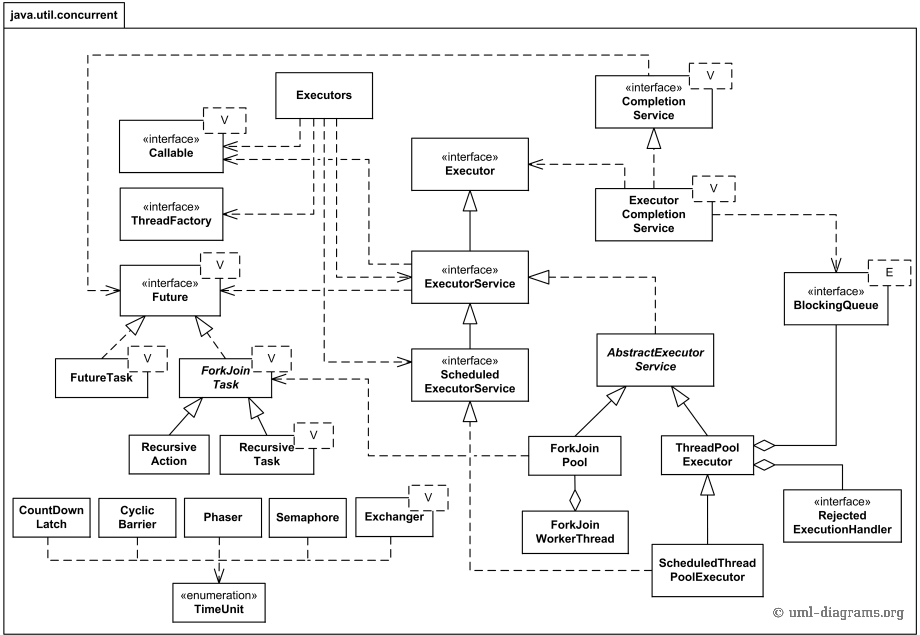
ThreadPoolExecutor UML图: image image 8.1 在任务和执行策略之间隐形耦合 避免Thread starvation deadlock 8.2 设置线程池大小 8.3 配置ThreadPoolExecutor image 构造函数如下: public ThreadPoolExecutor(int corePoolSize, int maximumPoolSize, long keepAliveTime, TimeUnit unit, BlockingQueue<Runnable> workQueue, ThreadFactory threadFactory, RejectedExecutionHandler handler) { ... } 核心和最大池大小:如果运行的线程少于 corePoolSize,则创建新线程来处理请求(即一个Runnable实例),即使其它线程是空闲的。如果运行的线程多于 corePoolSize 而少于 maximumPoolSize,则仅当队列满时才创建新线程。 保持活动时间:如果池中当前有多于 corePoolSize 的线程,则这些多出的线程在空闲时间超过 keepAliveTime 时将会终止。 排队:如果运行的线程等于或多于 corePoolSize,则 Executor 始终首选将请求加入队列BlockingQueue,而不添加新的线程。 被拒绝的任务:当 Executor 已经关闭,或者队列已满且线程数量达到maximumPoolSize时(即线程池饱和了),请求将被拒绝。这些拒绝的策略叫做Saturation Policy,即饱和策略。包括AbortPolicy, CallerRunsPolicy, DiscardPolicy, and DiscardOldestPolicy. 另外注意: 如果运行的线程少于 corePoolSize,ThreadPoolExecutor 会始终首选创建新的线程来处理请求;注意,这时即使有空闲线程也不会重复使用(这和数据库连接池有很大差别)。 如果运行的线程等于或多于 corePoolSize,则 ThreadPoolExecutor 会将请求加入队列BlockingQueue,而不添加新的线程(这和数据库连接池也不一样)。 如果无法将请求加入队列(比如队列已满),则创建新的线程来处理请求;但是如果创建的线程数超出 maximumPoolSize,在这种情况下,请求将被拒绝。 newCachedThreadPool使用了SynchronousQueue,并且是无界的。 线程工厂ThreadFactory 8.4 扩展ThreadPoolExecutor 重写beforeExecute和afterExecute方法。 8.5 递归算法的并行化 实际就是类似Number of Islands或者N-Queens等DFS问题的一种并行处理。 串行版本如下: public class SequentialPuzzleSolver <P, M> { private final Puzzle<P, M> puzzle; private final Set<P> seen = new HashSet<P>(); public SequentialPuzzleSolver(Puzzle<P, M> puzzle) { this.puzzle = puzzle; } public List<M> solve() { P pos = puzzle.initialPosition(); return search(new PuzzleNode<P, M>(pos, null, null)); } private List<M> search(PuzzleNode<P, M> node) { if (!seen.contains(node.pos)) { seen.add(node.pos); if (puzzle.isGoal(node.pos)) return node.asMoveList(); for (M move : puzzle.legalMoves(node.pos)) { P pos = puzzle.move(node.pos, move); PuzzleNode<P, M> child = new PuzzleNode<P, M>(pos, move, node); List<M> result = search(child); if (result != null) return result; } } return null; } } 并行版本如下: public class ConcurrentPuzzleSolver <P, M> { private final Puzzle<P, M> puzzle; private final ExecutorService exec; private final ConcurrentMap<P, Boolean> seen; protected final ValueLatch<PuzzleNode<P, M>> solution = new ValueLatch<PuzzleNode<P, M>>(); public ConcurrentPuzzleSolver(Puzzle<P, M> puzzle) { this.puzzle = puzzle; this.exec = initThreadPool(); this.seen = new ConcurrentHashMap<P, Boolean>(); if (exec instanceof ThreadPoolExecutor) { ThreadPoolExecutor tpe = (ThreadPoolExecutor) exec; tpe.setRejectedExecutionHandler(new ThreadPoolExecutor.DiscardPolicy()); } } private ExecutorService initThreadPool() { return Executors.newCachedThreadPool(); } public List<M> solve() throws InterruptedException { try { P p = puzzle.initialPosition(); exec.execute(newTask(p, null, null)); // block until solution found PuzzleNode<P, M> solnPuzzleNode = solution.getValue(); return (solnPuzzleNode == null) ? null : solnPuzzleNode.asMoveList(); } finally { exec.shutdown(); } } protected Runnable newTask(P p, M m, PuzzleNode<P, M> n) { return new SolverTask(p, m, n); } protected class SolverTask extends PuzzleNode<P, M> implements Runnable { SolverTask(P pos, M move, PuzzleNode<P, M> prev) { super(pos, move, prev); } public void run() { if (solution.isSet() || seen.putIfAbsent(pos, true) != null) return; // already solved or seen this position if (puzzle.isGoal(pos)) solution.setValue(this); else for (M m : puzzle.legalMoves(pos)) exec.execute(newTask(puzzle.move(pos, m), m, this)); } } }


资源下载

更多资源
腾讯云软件源

腾讯云软件源

为解决软件依赖安装时官方源访问速度慢的问题,腾讯云为一些软件搭建了缓存服务。您可以通过使用腾讯云软件源站来提升依赖包的安装速度。为了方便用户自由搭建服务架构,目前腾讯云软件源站支持公网访问和内网访问。

Nacos

Nacos

Nacos /nɑ:kəʊs/ 是 Dynamic Naming and Configuration Service 的首字母简称,一个易于构建 AI Agent 应用的动态服务发现、配置管理和AI智能体管理平台。Nacos 致力于帮助您发现、配置和管理微服务及AI智能体应用。Nacos 提供了一组简单易用的特性集,帮助您快速实现动态服务发现、服务配置、服务元数据、流量管理。Nacos 帮助您更敏捷和容易地构建、交付和管理微服务平台。

Rocky Linux

Rocky Linux

Rocky Linux(中文名:洛基)是由Gregory Kurtzer于2020年12月发起的企业级Linux发行版,作为CentOS稳定版停止维护后与RHEL(Red Hat Enterprise Linux)完全兼容的开源替代方案,由社区拥有并管理,支持x86_64、aarch64等架构。其通过重新编译RHEL源代码提供长期稳定性,采用模块化包装和SELinux安全架构,默认包含GNOME桌面环境及XFS文件系统,支持十年生命周期更新。

Sublime Text

Sublime Text

Sublime Text具有漂亮的用户界面和强大的功能,例如代码缩略图,Python的插件,代码段等。还可自定义键绑定,菜单和工具栏。Sublime Text 的主要功能包括:拼写检查,书签,完整的 Python API , Goto 功能,即时项目切换,多选择,多窗口等等。Sublime Text 是一个跨平台的编辑器,同时支持Windows、Linux、Mac OS X等操作系统。

用户登录
用户注册