0.前言
本文从代码角度来谈下 Mixtral 8x7B 混合专家Pytorch的实现
1.论文概述
Mixtral-8x7B 引爆了MoE的技术方向,更多针对MoE优化的Trick出现,回归模型本身来解析:
Mixtral 8x7B 采用了 sMoE模型结构,模型的细节如何?路由负载均衡如何计算?代码如何实现?
Mixtral 8x7B 的训练流程和推理流程是怎么样的,如何提高训练和推理效率?
Mixtral 8x7B 的模型参数是如何计算的?
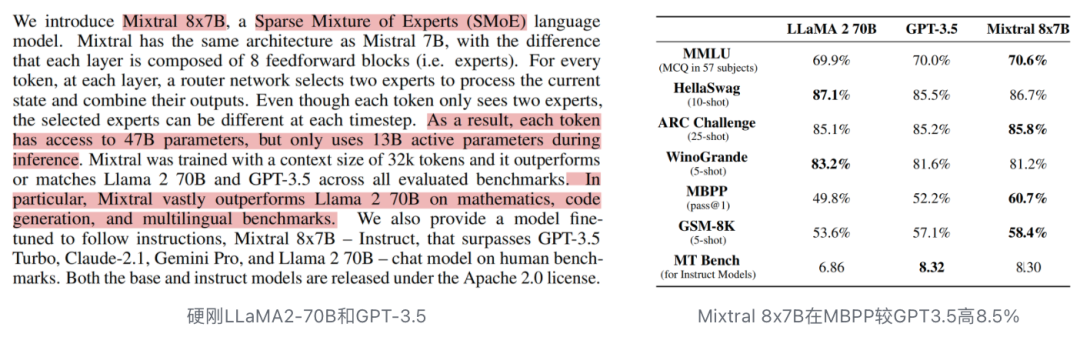
Mixtral 8x7B 性能硬刚 LLaMA2-70B和 GPT-3.5, 性能一线水准,在 MBPP代码能力超越 3.5
2. Mixtral 8x7B 模型架构和计算流程
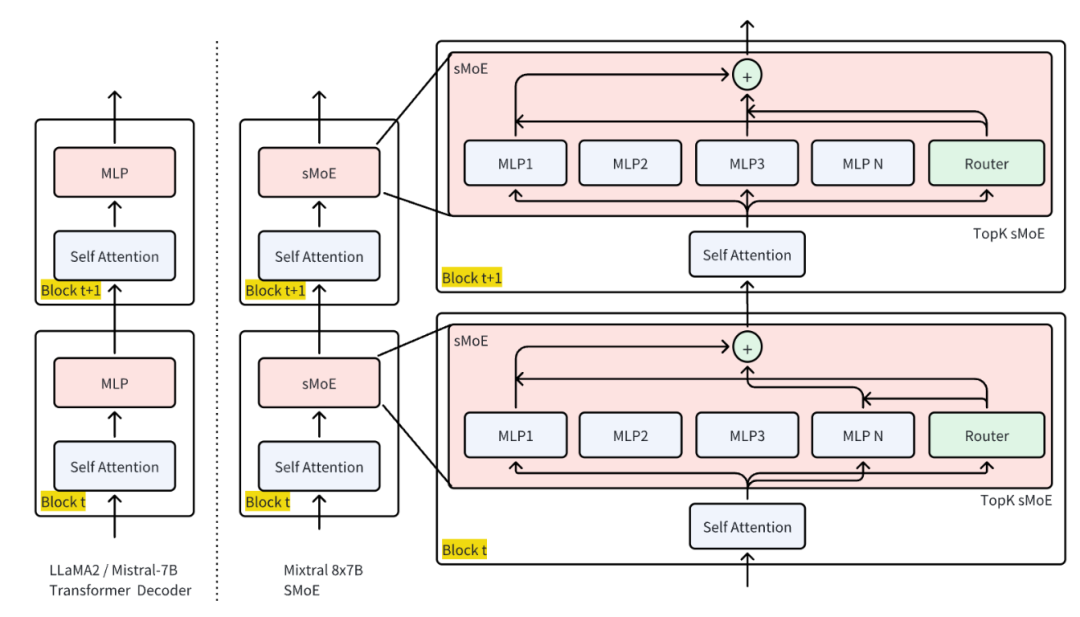
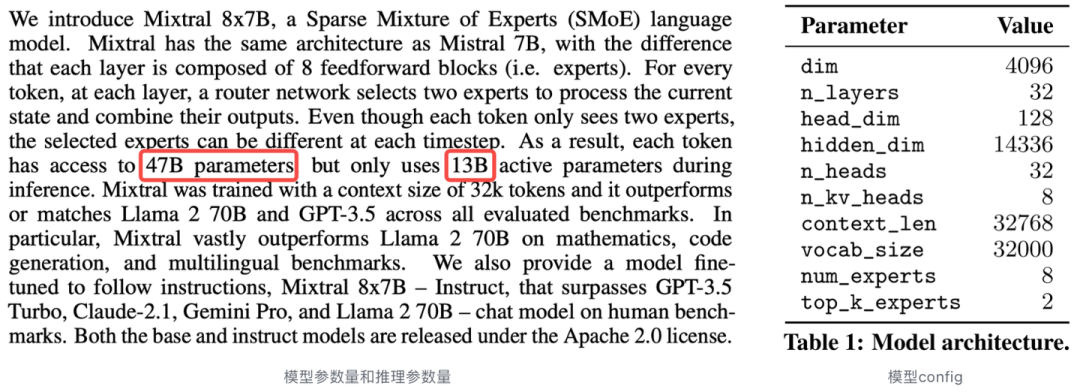
Mixtral is based on a transformer architecture [31] and uses the same modifications as described in [18] , with the notable exceptions that Mixtral supports a fully dense context length of 32k tokens, and the feed forward blocks are replaced by Mixture-of-Expert layers (Section 2.1). The model architecture parameters are summarized in Table 1.
base的模型结构为 Transformers的改版 Mistral-7B
MoE 作用在 Feed Forward Blocks上
2.1 Mixtral 模型架构
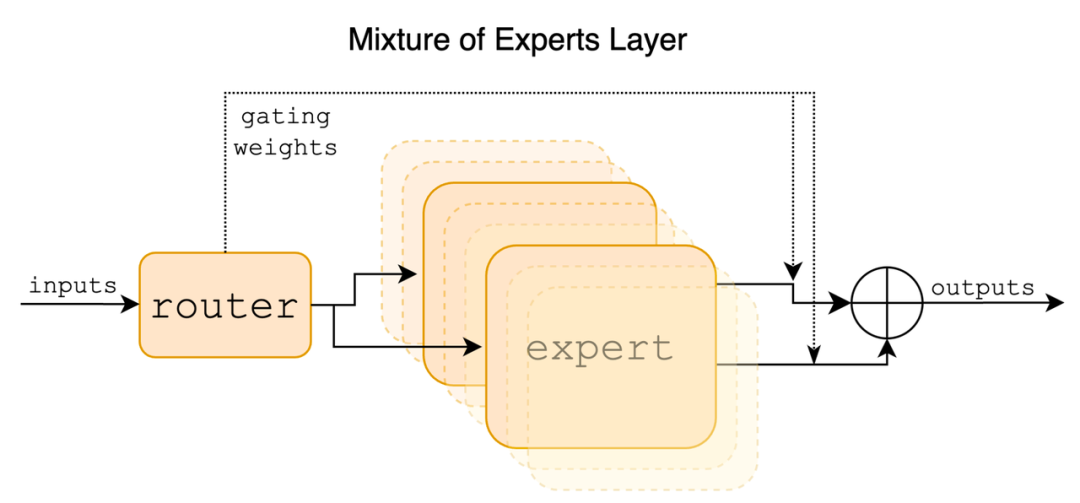
In a Transformer model, the MoE layer is applied independently per token and replaces the feed-forward (FFN) sub-block of the transformer block. For Mixtral we use the same SwiGLU architecture as the expert function Ei(x) and set K = 2. This means each token is routed to two SwiGLU sub-blocks with different sets of weights. Taking this all together, the output y for an input token x is computed as:
以 LLaMA2或 Mistral-7B来说其 MLP都是 SwiGLU形式
在 Mixtral-8x7B中 每层 的 Decoder层的 MLP都以 sMoE来替换掉
Transformers Mixtral-of-Expert
代码实现:
在Huggingface的Transformers框架中, Mixtral主要有两部分组成
MixtralSparseMoeBlock:替换掉原有的MLP层
MixtralForCausalLM( (model): MixtralModel( (embed_tokens): Embedding(32000 , 128 ) (layers): ModuleList( (1 ): MixtralDecoderLayer( (self_attn): MixtralAttention( (q_proj): Linear(in_features=128 , out_features=128 , bias=False ) (k_proj): Linear(in_features=128 , out_features=128 , bias=False ) (v_proj): Linear(in_features=128 , out_features=128 , bias=False ) (o_proj): Linear(in_features=128 , out_features=128 , bias=False ) (rotary_emb): MixtralRotaryEmbedding() ) (block_sparse_moe): MixtralSparseMoeBlock( (gate): Linear(in_features=128 , out_features=8 , bias=False ) (experts): ModuleList( (0 -7 ): 8 x MixtralBLockSparseTop2MLP( (w1): Linear(in_features=128 , out_features=256 , bias=False ) (w2): Linear(in_features=256 , out_features=128 , bias=False ) (w3): Linear(in_features=128 , out_features=256 , bias=False ) (act_fn): SiLU() ) ) ) (input_layernorm): MixtralRMSNorm() (post_attention_layernorm): MixtralRMSNorm() ) ) (norm): MixtralRMSNorm() )
2.2 SMoE 层实现
2.2.1 单个 Expert 实现
import torchfrom torch import nnfrom transformers import MixtralConfigclass MixtralBLockSparseTop2MLP (nn.Module) : def __init__ (self, config: MixtralConfig) : super().__init__() self.ffn_dim = config.intermediate_size self.hidden_dim = config.hidden_size self.w1 = nn.Linear(self.hidden_dim, self.ffn_dim, bias=False ) self.w2 = nn.Linear(self.ffn_dim, self.hidden_dim, bias=False ) self.w3 = nn.Linear(self.hidden_dim, self.ffn_dim, bias=False ) self.act_fn = nn.SiLU() # Forward 是 SwiGLU def forward (self, hidden_states) : y = self.act_fn(self.w1(hidden_states)) * self.w3(hidden_states) y = self.w2(y) return y x = torch.randn(1 , 64 , 128 ) expert = MixtralBLockSparseTop2MLP(config) print('单个专家为原LLaMA的MLP层' ) print(expert) g = expert(x) print('单个专家输入:' , x.shape) print('单个专家输出结果:' , g.shape)
结果
单个专家为原LLaMA的MLP层 MixtralBLockSparseTop2MLP( (w1): Linear(in_features=128, out_features=256, bias=False) (w2): Linear(in_features=256, out_features=128, bias=False) (w3): Linear(in_features=128, out_features=256, bias=False) (act_fn): SiLU() ) 单个专家输入: torch.Size([1, 64, 128]) 单个专家输出结果: torch.Size([1, 64, 128])
2.2.2 混合Expert实现
class MixtralSparseMoeBlock (nn.Module) : def __init__ (self, config) : super().__init__() self.hidden_dim = config.hidden_size self.ffn_dim = config.intermediate_size self.num_experts = config.num_local_experts self.top_k = config.num_experts_per_tok # gating self.gate = nn.Linear(self.hidden_dim, self.num_experts, bias=False ) # 多个 SwiGLU MLP 层组成混合专家 self.experts = nn.ModuleList([MixtralBLockSparseTop2MLP(config) \ for _ in range(self.num_experts)]) x = torch.randn(1 , 64 , 128 ) experts = MixtralSparseMoeBlock(config) print('多个专家混合专家' ) print(experts)
在以上我们实现了模型的关键结构, 但是这里的sMoE的Forward并没有实现
2.3 SMoE 计算流程
2.3.1 Gating流程
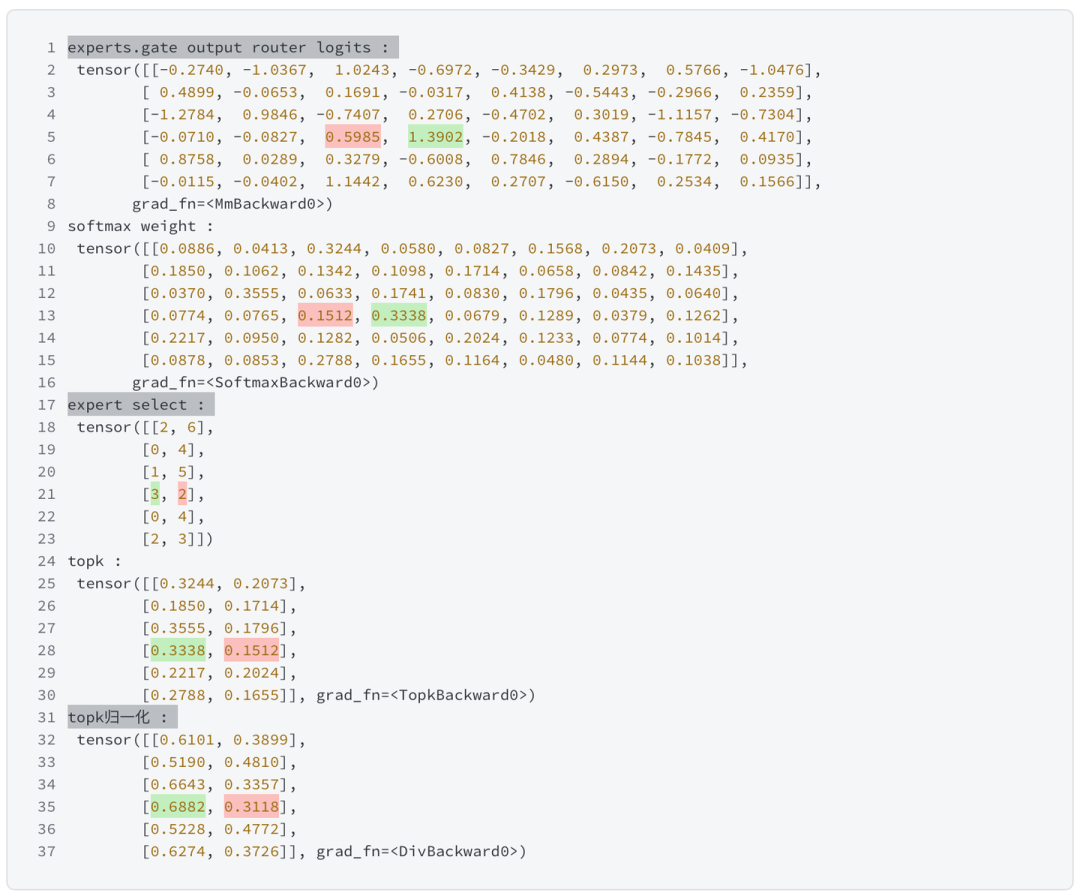
以下表示为多个token的gating计算流程
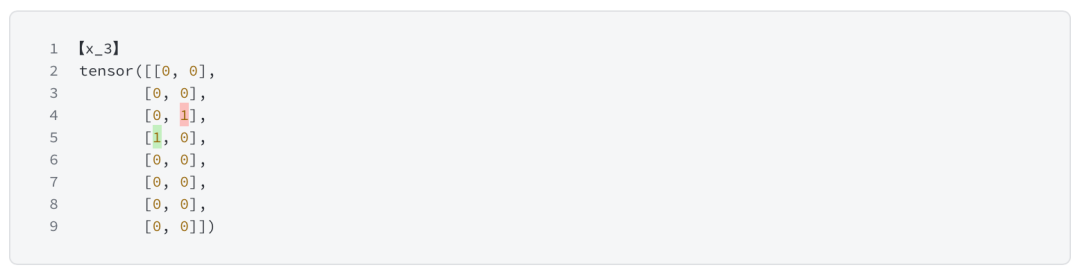
# 阶段一 # 计算稀疏 gating 值 tokens = 6 x = torch.randn(1 , tokens, 128 ) # 6个token hidden_states = x batch_size, sequence_length, hidden_dim = hidden_states.shape hidden_states = hidden_states.view(-1 , hidden_dim) # 每层都会产生router_logits, 将用于最后作 load balance loss router_logits = experts.gate(hidden_states) print(f'experts.gate output router logits : \n {router_logits} ' )# 计算 TopK 的 专家 logits 和 Top2 专家的位置 routing_weights = F.softmax(router_logits, dim=1 , dtype=torch.float) print(f'softmax weight : \n {routing_weights} ' ) routing_weights, selected_experts = torch.topk(routing_weights, \ experts.top_k, dim=-1 ) print(f'expert select : \n {selected_experts} ' ) print(f'topk : \n {routing_weights} ' ) routing_weights /= routing_weights.sum(dim=-1 , keepdim=True ) print(f'topk归一化 : \n {routing_weights} ' ) routing_weights = routing_weights.to(hidden_states.dtype)## One Hot 编码 expert_mask = torch.nn.functional.one_hot(selected_experts, \ num_classes=experts.num_experts).permute(2 , 1 , 0 )for i in range(tokens): print(f'【token_{i} 】\n' , expert_mask[:,:,i])
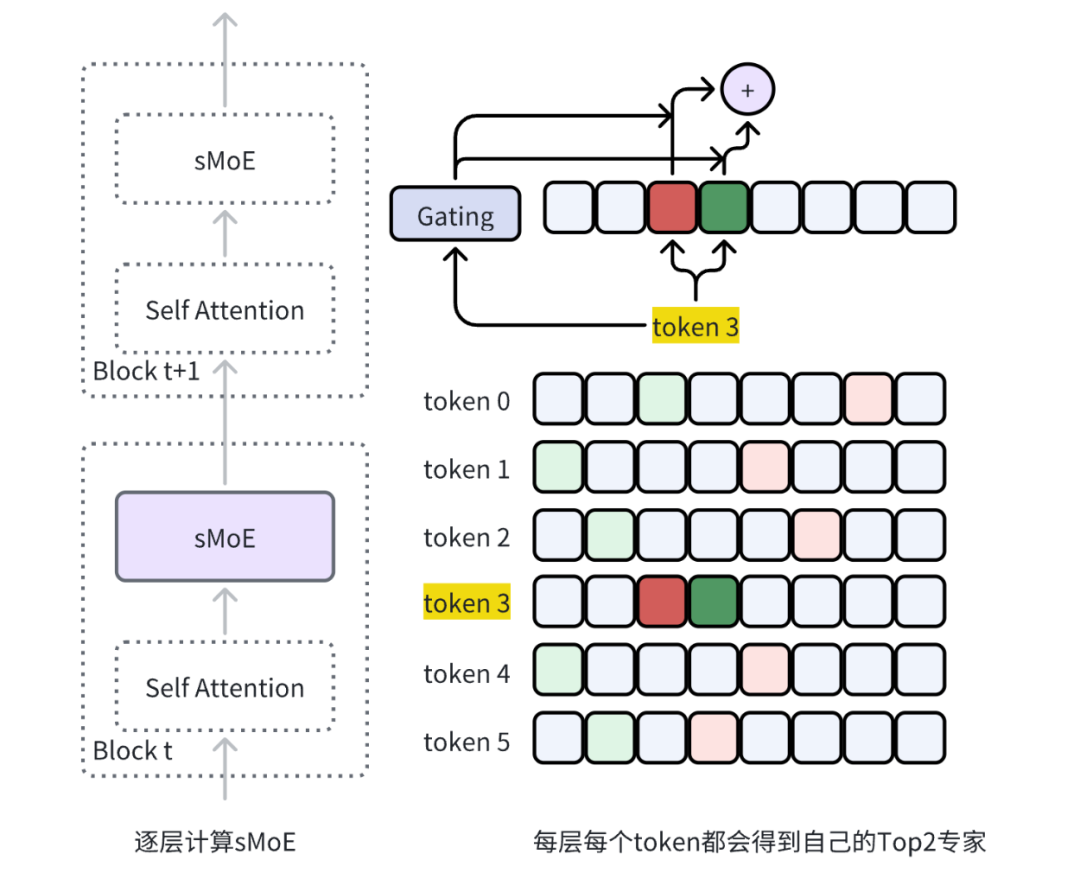
追踪x3的结果
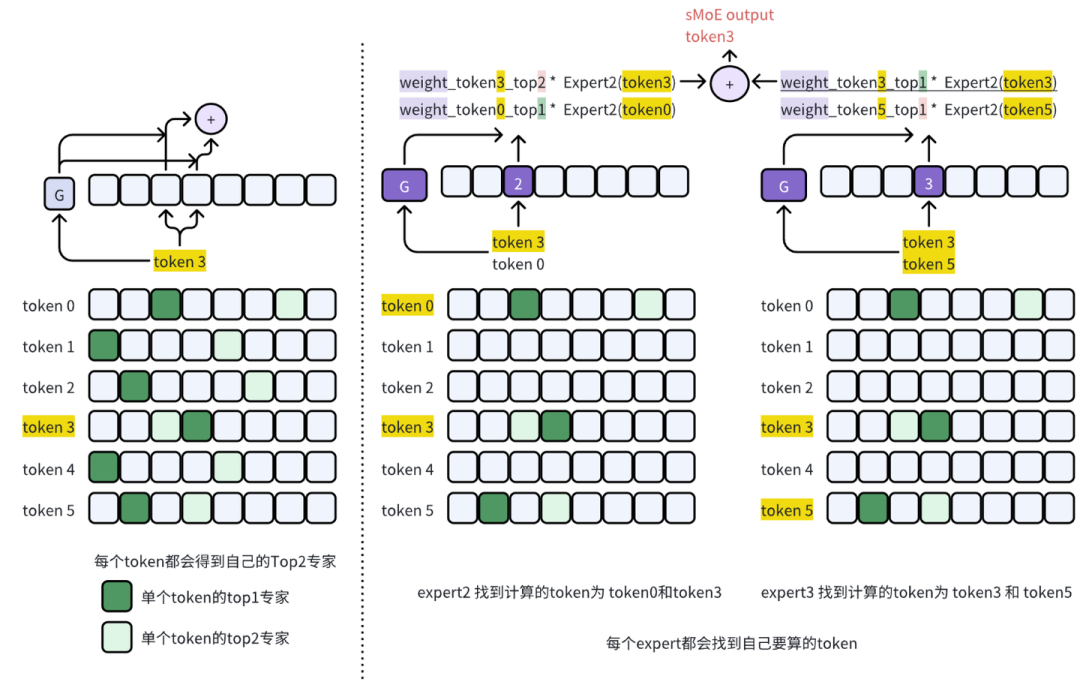
2.3.2 Expert 流程
token先序:左图为 token3选择 expert 2, expert 3号来计算 sMoE结果
expert先序:右图为依次计算 expert2和 expert3才得出 token3 的 sMoE结果
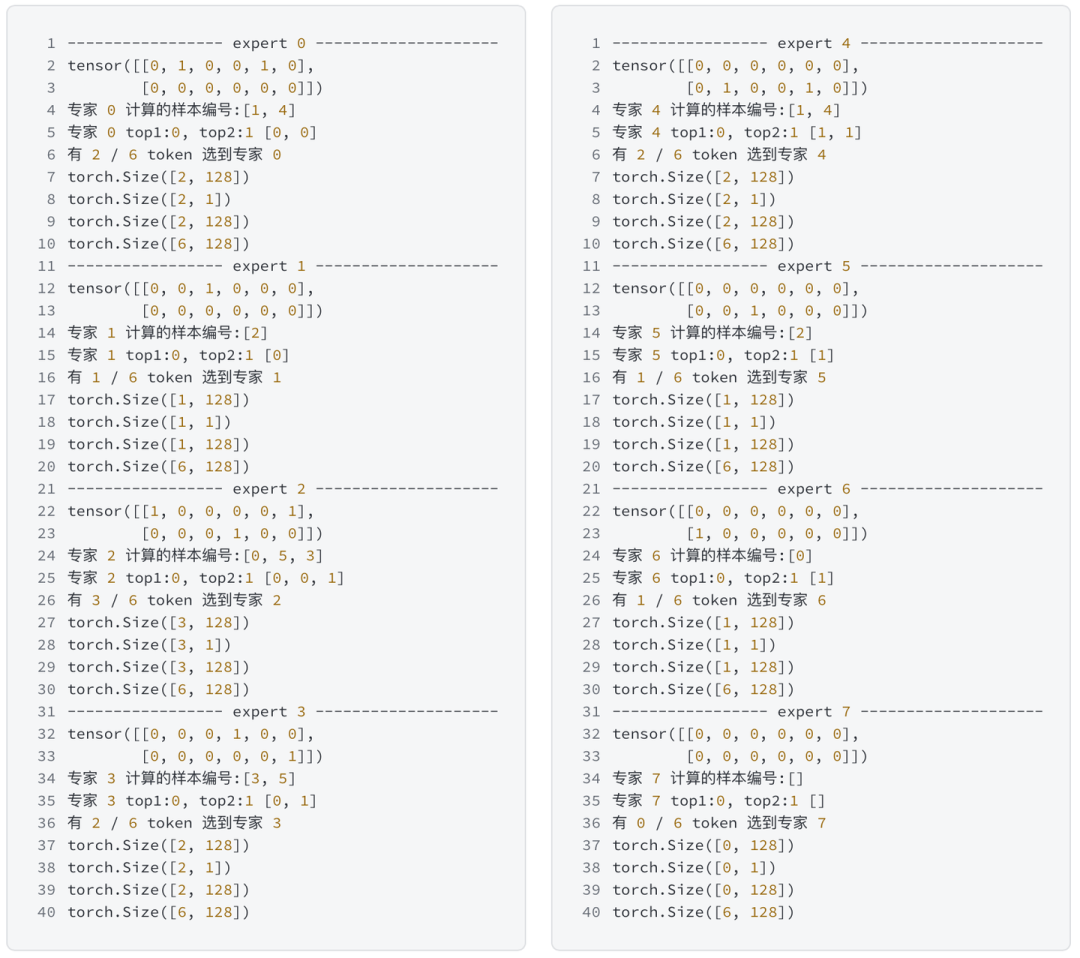
代码实现结果为:
## 最终结果 final_hidden_states = torch.zeros( (batch_size * sequence_length, hidden_dim), \ dtype=hidden_states.dtype, device=hidden_states.device ) print(f'final moe result shape for each token: {final_hidden_states.shape} ' )# 每个专家收集需要计算token for expert_idx in range(experts.num_experts): print(f'--------expert {expert_idx} ---------' ) expert_layer = experts.experts[expert_idx] print(expert_mask[expert_idx]) idx, top_x = torch.where(expert_mask[expert_idx]) print(f'专家 {expert_idx} 计算的样本编号:' ,top_x.tolist()) # select x_idx for expert top1 print(f'专家 {expert_idx} top1:0, top2:1 ' ,idx.tolist()) # 0 is top1 ,1 is top2 print(f'有 {len(top_x)} / {x.shape[1 ]} token 选到专家 {expert_idx} ' ) top_x_list = top_x.tolist() idx_list = idx.tolist() current_state = hidden_states[None , top_x_list].reshape(-1 , hidden_dim) # expert_0(x) * routing_weights current_hidden_states = expert_layer(current_state) \ * routing_weights[top_x_list, idx_list, None ] # 将计算的单个专家结果填入到结果表里 final_hidden_states.index_add_(0 , top_x, current_hidden_states.to(hidden_states.dtype)) print(current_state.shape) print(routing_weights[top_x_list, idx_list, None ].shape) print(current_hidden_states.shape) print(final_hidden_states.shape)
输出结果为:
2.4 Router Load Balence 计算
路由负载均衡的实现来自Switch Transformers
Computes auxiliary load balancing loss as in Switch Transformer - implemented in Pytorch. See Switch Transformer for more details. This function implements the loss function presented in equations (4) - (6) of the paper. It aims at penalizing cases where the routing between experts is too unbalanced.
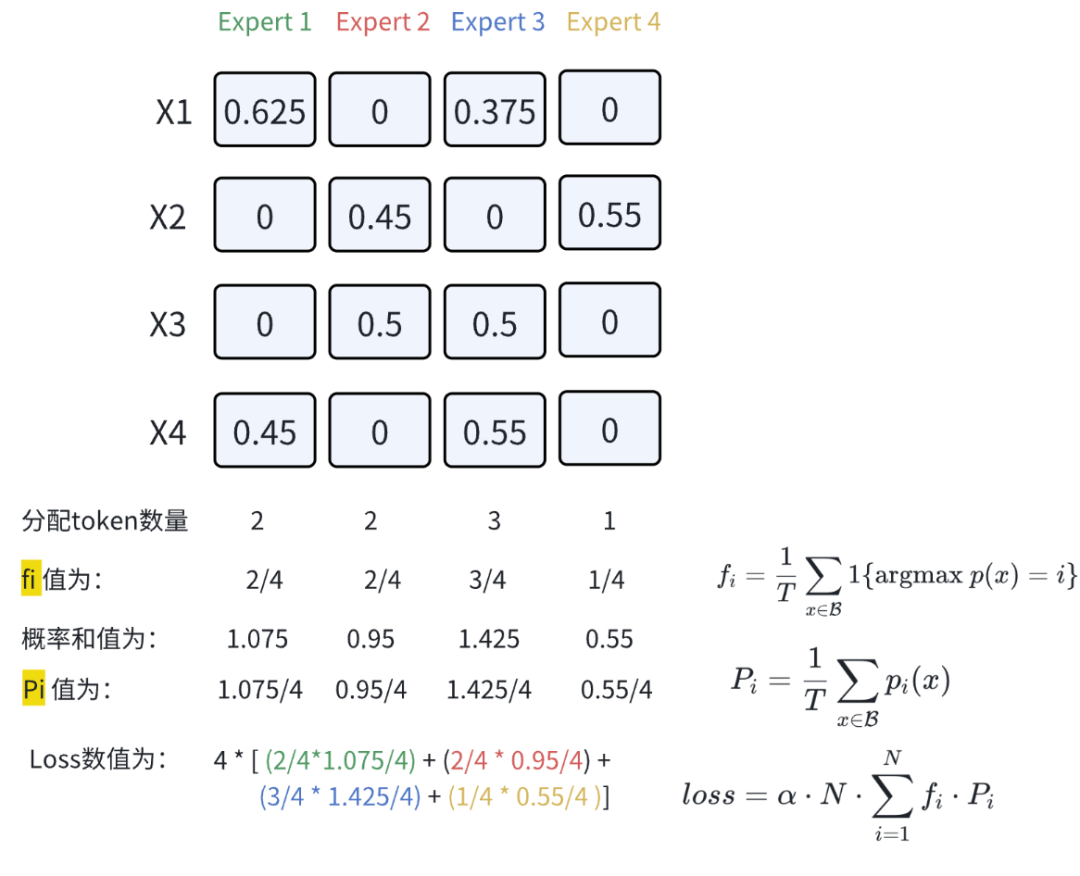
2.4.1 Switch Transformers Load Balance Loss
该算法为sMoE简化版load balance , 去除了原版 balance loss 估计
fi:在一个batch中第i专家分配到token的数量概率
Pi:在一个batch中T个tokens,各个专家选到tokens的概率和
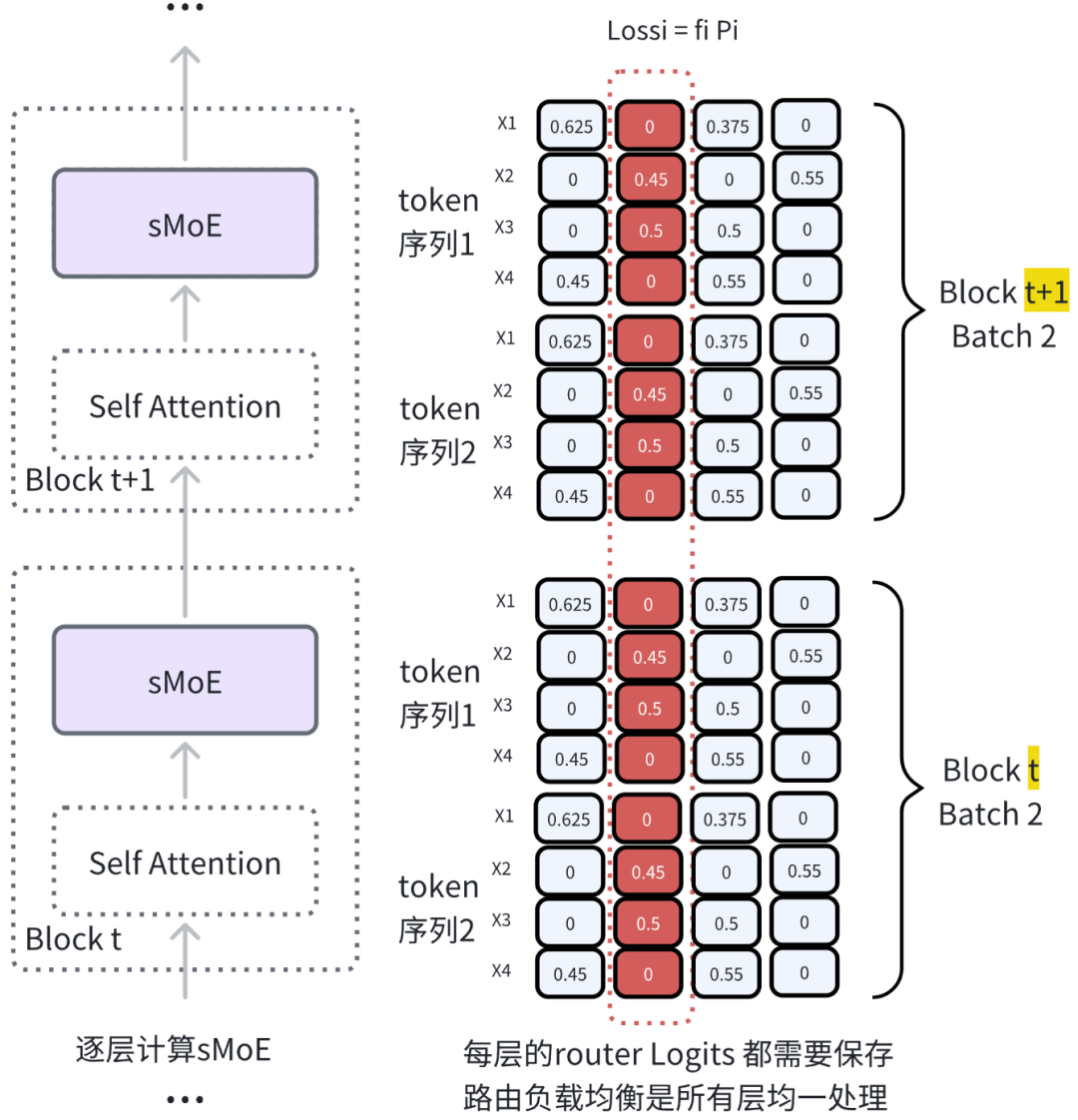
2.4.2 手撕Mixtral Load Balance Loss 计算流程
可以想象下layer norm只是在当前层 里对所有tokens 做,而负载均衡处理范围更广,对所有层 的tokens ,在每个expert的纵向计算出单专家负载值,求和便得到整个网络的负载均衡 loss
2.4.3 手撕Mixtral Load Balance
import torch num_experts = 8 batch = 10 seq_length = 6 top_k = 2 print(f'sMoE num_experts:{num_experts} top_k:{top_k} batch:{batch} seq_length:{seq_length} ' ) router_logits_1 = torch.randn(batch, seq_length, num_experts).view(-1 ,num_experts) # layer 1 router_logits_2 = torch.randn(batch, seq_length, num_experts).view(-1 ,num_experts) # layer 2 router_logits = [router_logits_1, router_logits_2] concatenated_gate_logits = torch.cat(router_logits, dim = 0 ) print('单层gating的路由logits:' , router_logits_1.shape) print('两层gating的路由logits:' , concatenated_gate_logits.shape) print('根据logits top-k 计算热独编码' ) routing_weights = torch.nn.functional.softmax(concatenated_gate_logits, dim=-1 ) _, selected_experts = torch.topk(routing_weights, top_k, dim=-1 ) expert_mask = torch.nn.functional.one_hot(selected_experts, num_experts) print(expert_mask.shape) tokens_sum_expert = torch.sum(expert_mask.float(), dim=0 ) tokens_per_expert = torch.mean(expert_mask.float(), dim=0 ) print(f'top1 每个专家平均处理的token :' , tokens_sum_expert[0 ]) print(f'top2 每个专家平均处理的token fi:' , tokens_per_expert[1 ]) print(f'top1与top2水平合计' , tokens_per_expert.sum(dim=1 ))# Compute the average probability of routing to these experts router_prob_per_expert = torch.mean(routing_weights, dim=0 ) print('router_prob_per_expert Pi: ' , router_prob_per_expert) print( '每个专家的负载:' , tokens_per_expert * router_prob_per_expert.unsqueeze(0 )) overall_loss = torch.sum(tokens_per_expert * router_prob_per_expert.unsqueeze(0 )) print('final loss:' , overall_loss)
计算结果
sMoE num_experts:8 top_k:2 batch:10 seq_length:6 单层gating的路由logits: torch.Size([60 , 8 ]) 两层gating的路由logits: torch.Size([120 , 8 ]) 根据logits top-k 计算热独编码 torch.Size([120 , 2 , 8 ]) top1 每个专家平均处理的token : tensor([10. , 14. , 19. , 17. , 14. , 9. , 17. , 20. ]) top2 每个专家平均处理的token fi: tensor([0.1667 , 0.1333 , 0.1833 , 0.0833 , 0.1167 , 0.1500 , 0.0667 , 0.1000 ]) top1与top2水平合计 tensor([1. , 1. ]) router_prob_per_expert Pi: tensor([0.1236 , 0.1184 , 0.1351 , 0.1168 , 0.1311 , 0.1147 , 0.1156 , 0.1447 ]) 每个专家的负载:tensor([[0.0103 , 0.0138 , 0.0214 , 0.0165 , 0.0153 , 0.0086 , 0.0164 , 0.0241 ], [0.0206 , 0.0158 , 0.0248 , 0.0097 , 0.0153 , 0.0172 , 0.0077 , 0.0145 ]]) final loss: tensor(0.2520 )
这里的gating logits 是跨batch跨层的,作用在每个token上
3. Mixtral 8x7B 参数量计算
3.1 原论文描述
这里的13B 是指单个 token涉及的模型参数量,实际推理时每个token都有不同的expert ,那么实际运行还是跑47B 参数的, 使用了sMoE 并不会减少显存占用。
3.2 模型参数量计算
忽略GQA计算
dim = 4096 n_layers = 32 head_dim = 128 hidden_dim = 14336 n_heads = 32 n_kv_heads = 8 # ignore GQA vocab_size = 32000 num_experts = 8 top_k_experts = 2 # attention mlp layernorm llama_num = n_layers * (dim * dim * 4 + hidden_dim * dim * 3 + 2 * dim ) \ + 2 * vocab_size * dim print('llama:' , llama_num)# attention 【mlp*8】 layernorm moe_num = n_layers * (dim * dim * 4 + hidden_dim * dim * 3 * 8 + 2 * dim ) \ + 2 * vocab_size * dim print('moe:' , moe_num)# attention 【mlp*2】 layernorm # ToP2-inference moe_num = n_layers * (dim * dim * 4 + hidden_dim * dim * 3 * 2 + 2 * dim ) \ + 2 * vocab_size * dim print('moe top-2:' , moe_num)
结果
llama: 8047034368 moe: 47507046400 moe top-2: 13684178944
4. MoE 扩展
4.1 MegaBlocks
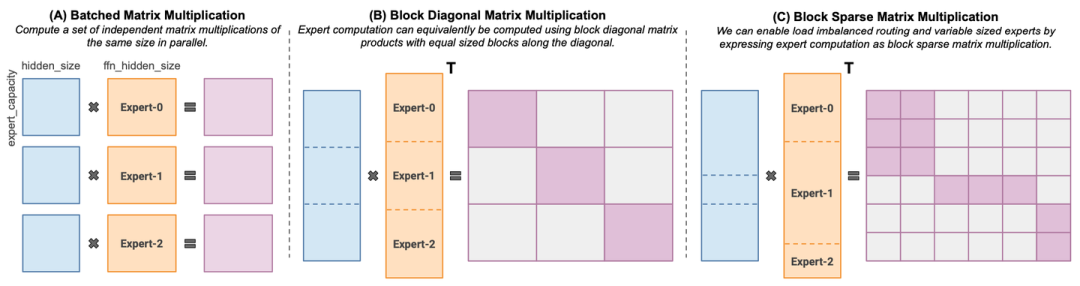
MoE layers can be run efficiently on single GPUs with high performance specialized kernels. For example, Megablocks
MegaBlocks实现稀疏的MoE计算
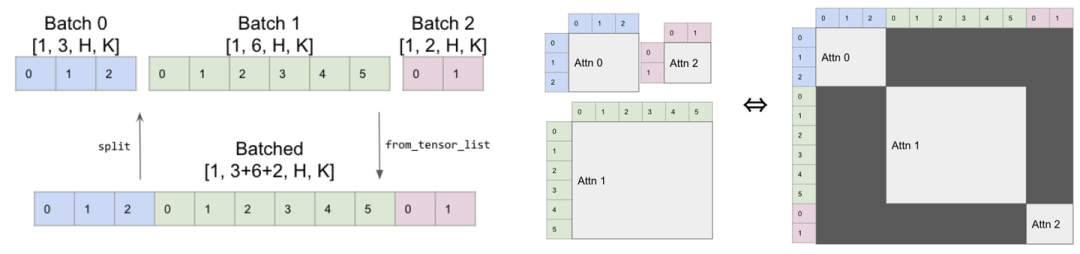
题外话:XFormers也实现了类似思想的算子,batch里的attention通过Mask实现多序列稀疏计算。
4.2 GShard
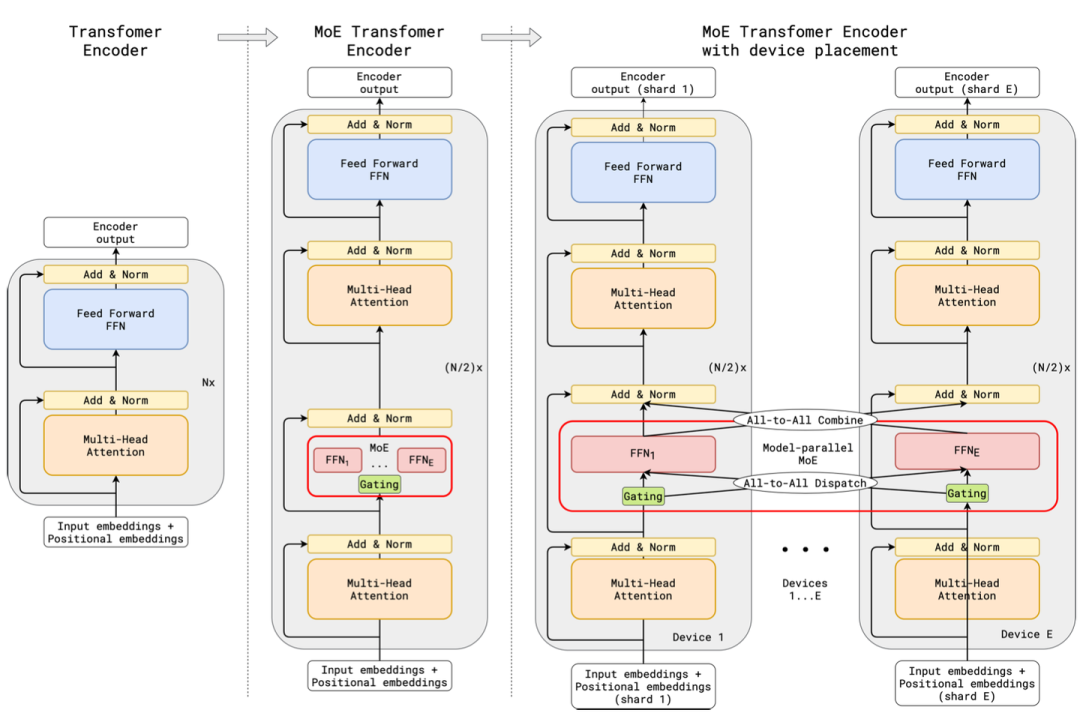
Mixtral论文里在load balance里提了一下GShard, 是首篇将MoE引入到Transformers的工作
This formulation is similar to the GShard architecture [21], with the exceptions that we replace all FFN sub-blocks by MoE layers while GShard replaces every other block, and that GShard uses a more elaborate gating strategy for the second expert assigned to each token.
GShard在不同GPU上分配不同的专家,其他参数都共享,数据派发到专家,专家结果汇总都由All-to-All算子实现
DeepSpeed-MoE源码对All-to-All的实现如下
class _AllToAll (torch.autograd.Function) : @staticmethod def forward ( ctx: Any, # TODO: replace with DS process group group: torch.distributed.ProcessGroup, input: Tensor) -> Tensor:# type: ignore ctx.group = group input = input.contiguous() output = torch.empty_like(input) dist.all_to_all_single(output, input, group=group) return output @staticmethod def backward (ctx: Any, *grad_output: Tensor) -> Tuple[None , Tensor]: return (None , _AllToAll.apply(ctx.group, *grad_output)) class MOELayer (Base) : # ... def forward (self, *input: Tensor, **kwargs: Any) -> Tensor: # ... dispatched_input = _AllToAll.apply(self.ep_group, dispatched_input) # Re-shape after all-to-all: ecm -> gecm dispatched_input = dispatched_input.reshape(self.ep_size, self.num_local_experts, -1 , d_model) expert_output = self.experts(dispatched_input) expert_output = _AllToAll.apply(self.ep_group, expert_output) #...
4.3 DeepSpeed-MoE
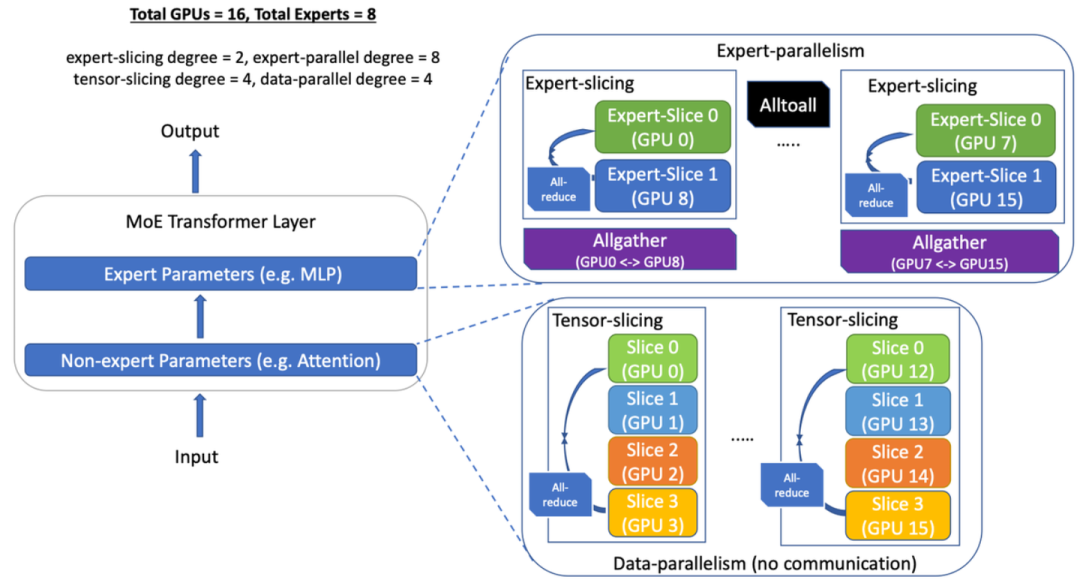
更加工程化的实现可以看 DeepSpeed-MoE的开源方案
MoE层使用 Expert-Paralallelism做并行 AlltoAll实现如上
4.4 LLaMA-MoE
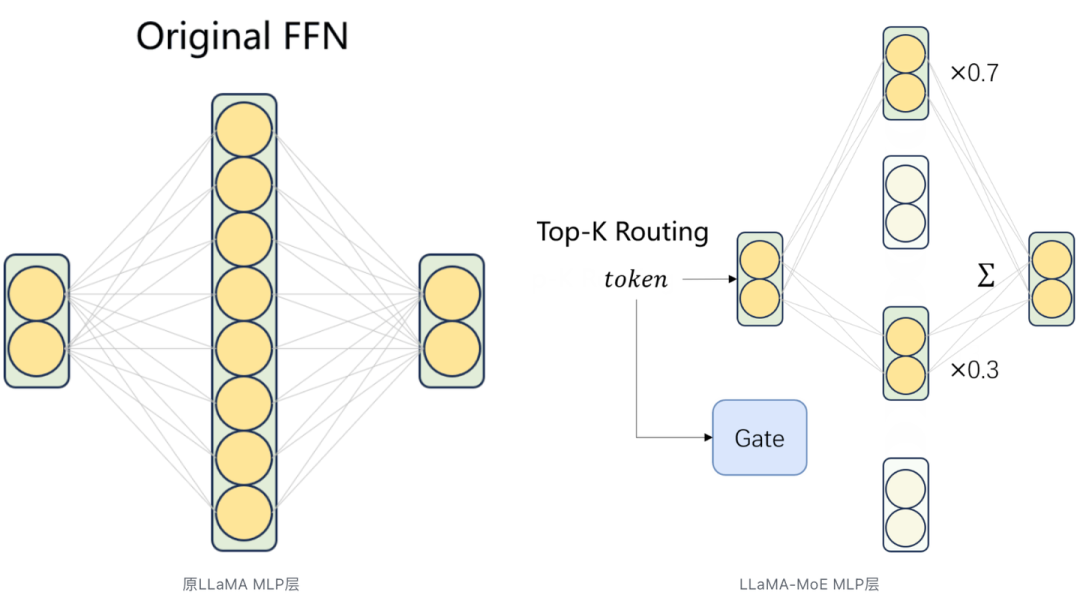
Mixtral 8x7B训不动?试试将LLaMA原MLP改造成LLaMA-MoE
LLaMA-MoE 上关键代码是用LinearGLUExperts代替原本LLaMA里的SwiGLU层
class LinearGLUExperts(nn.Module): # ... def __init__(...): # ... # 每个专家都创建SwiGLU MLP层 for i in range(num_experts): # this matrix will be transposed when performing linear forwarding this_expert_weight_gate = nn.Parameter( torch.empty((size_experts[i], in_features), **factory_kwargs) ) # this matrix will be transposed when performing linear forwarding this_expert_weight_up = nn.Parameter( torch.empty((size_experts[i], in_features), **factory_kwargs) ) # this matrix will be transposed when performing linear forwarding this_expert_weight_down = nn.Parameter( torch.empty((out_features, size_experts[i]), **factory_kwargs) ) self.weight_gate.append(this_expert_weight_gate) self.weight_up.append(this_expert_weight_up) self.weight_down.append(this_expert_weight_down) # ...
5. Mixtral 8x7B 总结 & 进一步阅读
Mixtral 8x7B实现并不复杂,其中 load-balance loss是 expert-wise维度计算的
当前发布的模型还是围绕模型结构展开的, 期待 mistral.AI上线创新的对齐方案
涉及到多机多卡的 sMoE分布式训练非常需要工程技巧, 不同的模型架构和集群可以有多种 DP\TP\EP..组合方案,
在·Mixtral·中对于实验反直觉论点 专家的知识是作用在 token 级别,而不是domain 级别,对 MoE 感兴趣的话可以进一步开盒分析
Reference
Mixture of Experts Explained
方佳瑞:MoE训练论文解读之Megablocks:打破动态路由限制
方佳瑞:MoE训练系统之JANUS:参数服务器助力MoE训练
方佳瑞:MoE训练论文解读之Tutel: 动态切换并行策略实现动态路由
西门宇少:对MoE大模型的训练和推理做分布式加速——DeepSpeed-MoE论文速读
吃果冻不吐果冻皮:大模型分布式训练并行技术(八)-MOE并行
Transformers-Mixtral-of-Experts
本文由 Hugging Face 中文社区内容共建项目提供,稿件由社区成员投稿,经授权发布于 Hugging Face 公众号。文章内容不代表官方立场,文中介绍的产品和服务等均不构成投资建议。了解更多请关注公众号:
如果你有与开源 AI、 Hugging Face 相关的技术和实践分享内容,以及最新的开源 AI 项目发布,希望通过我们分享给更多 AI 从业者和开发者们,请通过下面的链接投稿与我们取得联系: