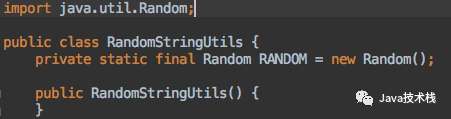
When this method is first called, it creates a single new pseudorandom-number generator, exactly as if by the expression new java.util.Random() This new pseudorandom-number generator is used thereafter for all calls to this method and is used nowhere else.
当第一次调用 Math.random() 方法时,自动创建了一个伪随机数生成器,实际上用的是 new java.util.Random()。当接下来继续调用 Math.random() 方法时,就会使用这个新的伪随机数生成器。
源码如下:
publicstaticdoublerandom(){ Random rnd = randomNumberGenerator; if (rnd == null) rnd = initRNG(); // 第一次调用,创建一个伪随机数生成器 return rnd.nextDouble(); }
privatestaticsynchronized Random initRNG(){ Random rnd = randomNumberGenerator; return (rnd == null) ? (randomNumberGenerator = new Random()) : rnd; // 实际上用的是new java.util.Random() }
This method is properly synchronized to allow correct use by more than one thread. However, if many threads need to generate pseudorandom numbers at a great rate, it may reduce contention for each thread to have its own pseudorandom-number generator.
基本算法:linear congruential pseudorandom number generator (LGC) 线性同余法伪随机数生成器缺点:可预测
An attacker will simply compute the seed from the output values observed. This takes significantly less time than 2^48 in the case of java.util.Random. 从输出中可以很容易计算出种子值。It is shown that you can predict future Random outputs observing only two(!) output values in time roughly 2^16. 因此可以预测出下一个输出的随机数。You should never use an LCG for security-critical purposes.在注重信息安全的应用中,不要使用 LCG 算法生成随机数,请使用 SecureRandom。
使用:
Random random = new Random();

for (int i = 0; i < 5; i++) {
    System.out.println(random.nextInt());
}
Instances of java.util.Random are not cryptographically secure. Consider instead using SecureRandom to get a cryptographically secure pseudo-random number generator for use by security-sensitive applications.SecureRandom takes Random Data from your os (they can be interval between keystrokes etc - most os collect these data store them in files - /dev/random and /dev/urandom in case of linux/solaris) and uses that as the seed. 操作系统收集了一些随机事件,比如鼠标点击,键盘点击等等,SecureRandom 使用这些随机事件作为种子。
API 参考:https://commons.apache.org/proper/commons-lang/javadocs/api-2.6/org/apache/commons/lang/RandomStringUtils.html
示例:
publicclassRandomStringDemo { publicstaticvoidmain(String[] args) { // Creates a 64 chars length random string of number. String result = RandomStringUtils.random(64, false, true); System.out.println("random = " + result);
// Creates a 64 chars length of random alphabetic string. result = RandomStringUtils.randomAlphabetic(64); System.out.println("random = " + result);
// Creates a 32 chars length of random ascii string. result = RandomStringUtils.randomAscii(32); System.out.println("random = " + result);
// Creates a 32 chars length of string from the defined array of // characters including numeric and alphabetic characters. result = RandomStringUtils.random(32, 0, 20, true, true, "qw32rfHIJk9iQ8Ud7h0X".toCharArray()); System.out.println("random = " + result);
Rocky Linux(中文名:洛基)是由Gregory Kurtzer于2020年12月发起的企业级Linux发行版,作为CentOS稳定版停止维护后与RHEL(Red Hat Enterprise Linux)完全兼容的开源替代方案,由社区拥有并管理,支持x86_64、aarch64等架构。其通过重新编译RHEL源代码提供长期稳定性,采用模块化包装和SELinux安全架构,默认包含GNOME桌面环境及XFS文件系统,支持十年生命周期更新。
Sublime Text
Sublime Text具有漂亮的用户界面和强大的功能,例如代码缩略图,Python的插件,代码段等。还可自定义键绑定,菜单和工具栏。Sublime Text 的主要功能包括:拼写检查,书签,完整的 Python API , Goto 功能,即时项目切换,多选择,多窗口等等。Sublime Text 是一个跨平台的编辑器,同时支持Windows、Linux、Mac OS X等操作系统。