本文选自 Doocs 开源社区旗下“源码猎人 ”项目,作者 AmyliaY。https://github.com/doocs/source-code-hunter
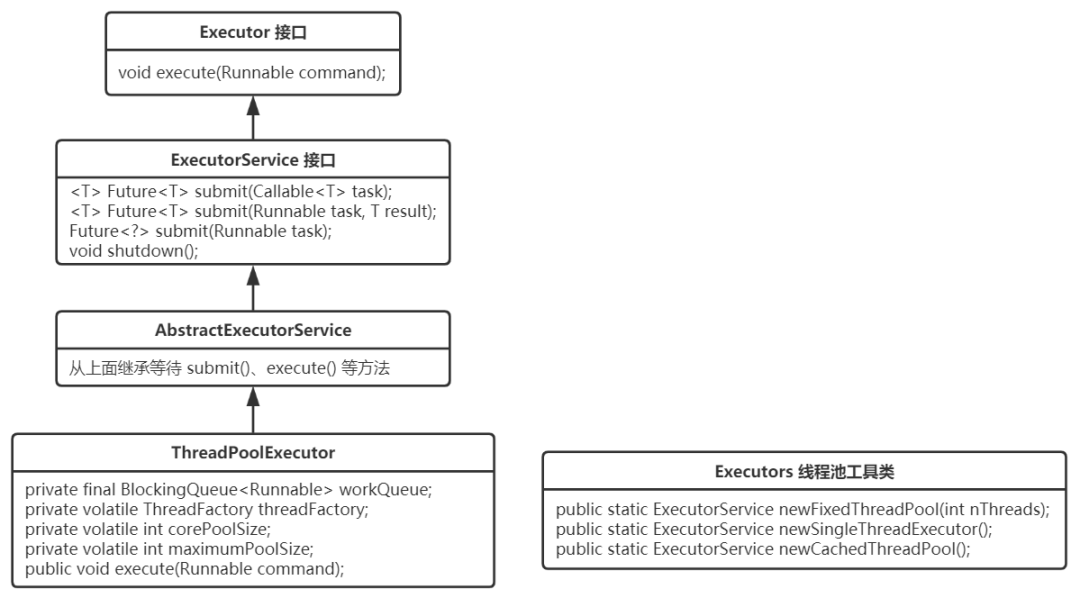
线程池核心组件图解
看源码之前,先了解一下该组件 最主要的几个 接口、抽象类和实现类的结构关系。
该组件中,Executor 和 ExecutorService 接口 定义了线程池最核心的几个方法,提交任务 submit ()、关闭线程池 shutdown()。抽象类 AbstractExecutorService 主要对公共行为 submit()系列方法进行了实现,这些 submit()方法 的实现使用了 模板方法模式,其中调用的 execute()方法 是未实现的 来自 Executor 接口 的方法。实现类 ThreadPoolExecutor 则对线程池进行了具体而复杂的实现。
另外还有一个常见的工具类 Executors,里面为开发者封装了一些可以直接拿来用的线程池。
源码赏析
话不多说,直接上源码。(这里只看最主要的代码部分)
Executor 和 ExecutorService 接口
public interface Executor { /** * 在将来的某个时间执行给定的 Runnable 。该 Runnable 可以在新线程、池线程或调用线程中执行。 */ void execute ( Runnable command ); } public interface ExecutorService extends Executor { /** * 优雅关闭,该关闭会继续执行完以前提交的任务,但不再接受新任务。 */ void shutdown (); /** * 提交一个有返回值的任务,并返回该任务的 未来执行完成后的结果。 * Future 的 get ()方法 将在成功完成后返回任务的结果。 */ <T> Future <T> submit(Callable <T> task); <T> Future <T> submit(Runnable task, T result); Future <?> submit ( Runnable task ); }
AbstractExecutorService 抽象类
/** * 该抽象类最主要的内容就是,实现了 ExecutorService 中的 submit ()系列方法 */ public abstract class AbstractExecutorService implements ExecutorService { /** * 提交任务 进行执行,返回获取未来结果的 Future 对象。 * 这里使用了 “模板方法模式”, execute ()方法来自 Executor 接口,该抽象类中并未进行实现, * 而是交由子类具体实现。 */ public Future <?> submit ( Runnable task ) { if ( task == null ) throw new NullPointerException (); RunnableFuture < Void > ftask = newTaskFor ( task , null ); execute ( ftask ); return ftask ; } public < T > Future < T > submit ( Runnable task , T result ) { if ( task == null ) throw new NullPointerException (); RunnableFuture < T > ftask = newTaskFor ( task , result ); execute ( ftask ); return ftask ; } public < T > Future < T > submit ( Callable < T > task ) { if ( task == null ) throw new NullPointerException (); RunnableFuture < T > ftask = newTaskFor ( task ); execute ( ftask ); return ftask ; } }
ThreadPoolExecutor
public class ThreadPoolExecutor extends AbstractExecutorService { /** * ************** * ** 主要属性 ** * ************** */ /** 阻塞队列 */ private final BlockingQueue < Runnable > workQueue ; /** 用于创建线程的 线程工厂 */ private volatile ThreadFactory threadFactory ; /** 核心线程数 */ private volatile int corePoolSize ; /** 最大线程数 */ private volatile int maximumPoolSize ; /** * ************** * ** 构造方法 ** * ************** */ /** 最后都使用了最后一个构造方法的实现 */ public ThreadPoolExecutor ( int corePoolSize , int maximumPoolSize , long keepAliveTime , TimeUnit unit , BlockingQueue < Runnable > workQueue ) { this ( corePoolSize , maximumPoolSize , keepAliveTime , unit , workQueue , Executors . defaultThreadFactory (), defaultHandler ); } public ThreadPoolExecutor ( int corePoolSize , int maximumPoolSize , long keepAliveTime , TimeUnit unit , BlockingQueue < Runnable > workQueue , ThreadFactory threadFactory ) { this ( corePoolSize , maximumPoolSize , keepAliveTime , unit , workQueue , threadFactory , defaultHandler ); } public ThreadPoolExecutor ( int corePoolSize , int maximumPoolSize , long keepAliveTime , TimeUnit unit , BlockingQueue < Runnable > workQueue , RejectedExecutionHandler handler ) { this ( corePoolSize , maximumPoolSize , keepAliveTime , unit , workQueue , Executors . defaultThreadFactory (), handler ); } public ThreadPoolExecutor ( int corePoolSize , int maximumPoolSize , long keepAliveTime , TimeUnit unit , BlockingQueue < Runnable > workQueue , ThreadFactory threadFactory , RejectedExecutionHandler handler ) { if ( corePoolSize < 0 || maximumPoolSize <= 0 || maximumPoolSize < corePoolSize || keepAliveTime < 0 ) throw new IllegalArgumentException (); if ( workQueue == null || threadFactory == null || handler == null ) throw new NullPointerException (); this . corePoolSize = corePoolSize ; this . maximumPoolSize = maximumPoolSize ; this . workQueue = workQueue ; this . keepAliveTime = unit . toNanos ( keepAliveTime ); this . threadFactory = threadFactory ; this . handler = handler ; } /** * ************** * ** 主要实现 ** * ************** */ /** 执行 Runnable任务 */ public void execute ( Runnable command ) { if ( command == null ) throw new NullPointerException (); /* * 分三步进行: * * 1 、如果运行的线程少于 corePoolSize ,尝试开启一个新的线程;否则尝试进入工作队列 * * 2. 如果工作队列没满,则进入工作队列;否则 判断是否超出最大线程数 * * 3. 如果未超出最大线程数,则尝试开启一个新的线程;否则 按饱和策略处理无法执行的任务 */ int c = ctl . get (); if ( workerCountOf ( c ) < corePoolSize ) { if ( addWorker ( command , true )) return ; c = ctl . get (); } if ( isRunning ( c ) && workQueue . offer ( command )) { int recheck = ctl . get (); if (! isRunning ( recheck ) && remove ( command )) reject ( command ); else if ( workerCountOf ( recheck ) == 0 ) addWorker ( null , false ); } else if (! addWorker ( command , false )) reject ( command ); } /** * 优雅关闭,在其中执行以前提交的任务,但不接受新任务。如果已关闭,则调用没有其他效果。 */ public void shutdown () { final ReentrantLock mainLock = this . mainLock ; mainLock . lock (); try { checkShutdownAccess (); advanceRunState ( SHUTDOWN ); interruptIdleWorkers (); onShutdown (); // hook for ScheduledThreadPoolExecutor } finally { mainLock . unlock (); } tryTerminate (); } }
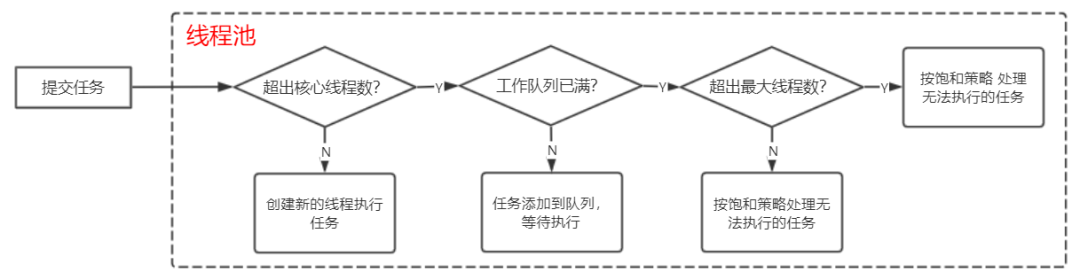
ThreadPoolExecutor 中的 execute()方法 执行 Runnable 任务 的流程逻辑可以用下图表示。
工具类 Executors
看类名也知道,它最主要的作用就是提供 static 的工具方法,为开发者提供各种封装好的 具有各自特性的线程池。
public class Executors { /** * 创建一个固定线程数量的线程池 */ public static ExecutorService newFixedThreadPool ( int nThreads ) { return new ThreadPoolExecutor ( nThreads , nThreads , 0L , TimeUnit . MILLISECONDS , new LinkedBlockingQueue < Runnable >()); } /** * 创建一个单线程的线程池 */ public static ExecutorService newSingleThreadExecutor () { return new FinalizableDelegatedExecutorService ( new ThreadPoolExecutor ( 1 , 1 , 0L , TimeUnit . MILLISECONDS , new LinkedBlockingQueue < Runnable >())); } /** * 创建一个缓存的,可动态伸缩的线程池。 * 可以看出来:核心线程数为 0 ,最大线程数为 Integer . MAX_VALUE ,如果任务数在某一瞬间暴涨, * 这个线程池很可能会把 服务器撑爆。 * 另外需要注意的是,它们底层都是使用了 ThreadPoolExecutor ,只不过帮我们配好了参数 */ public static ExecutorService newCachedThreadPool () { return new ThreadPoolExecutor ( 0 , Integer . MAX_VALUE , 60L , TimeUnit . SECONDS , new SynchronousQueue < Runnable >()); } }
全文完!
希望本文对大家有所帮助。如果感觉本文有帮助,有劳转发或点一下“在看”!让更多人收获知识!
长按识别下图二维码,关注公众号「Doocs 开源社区 」,第一时间跟你们分享好玩、实用的技术文章与业内最新资讯。