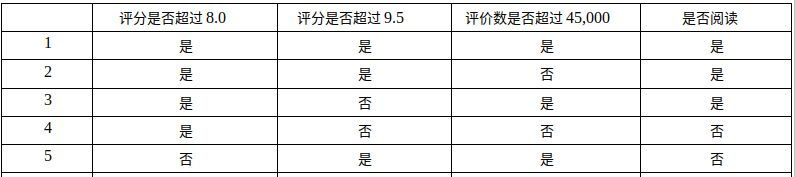
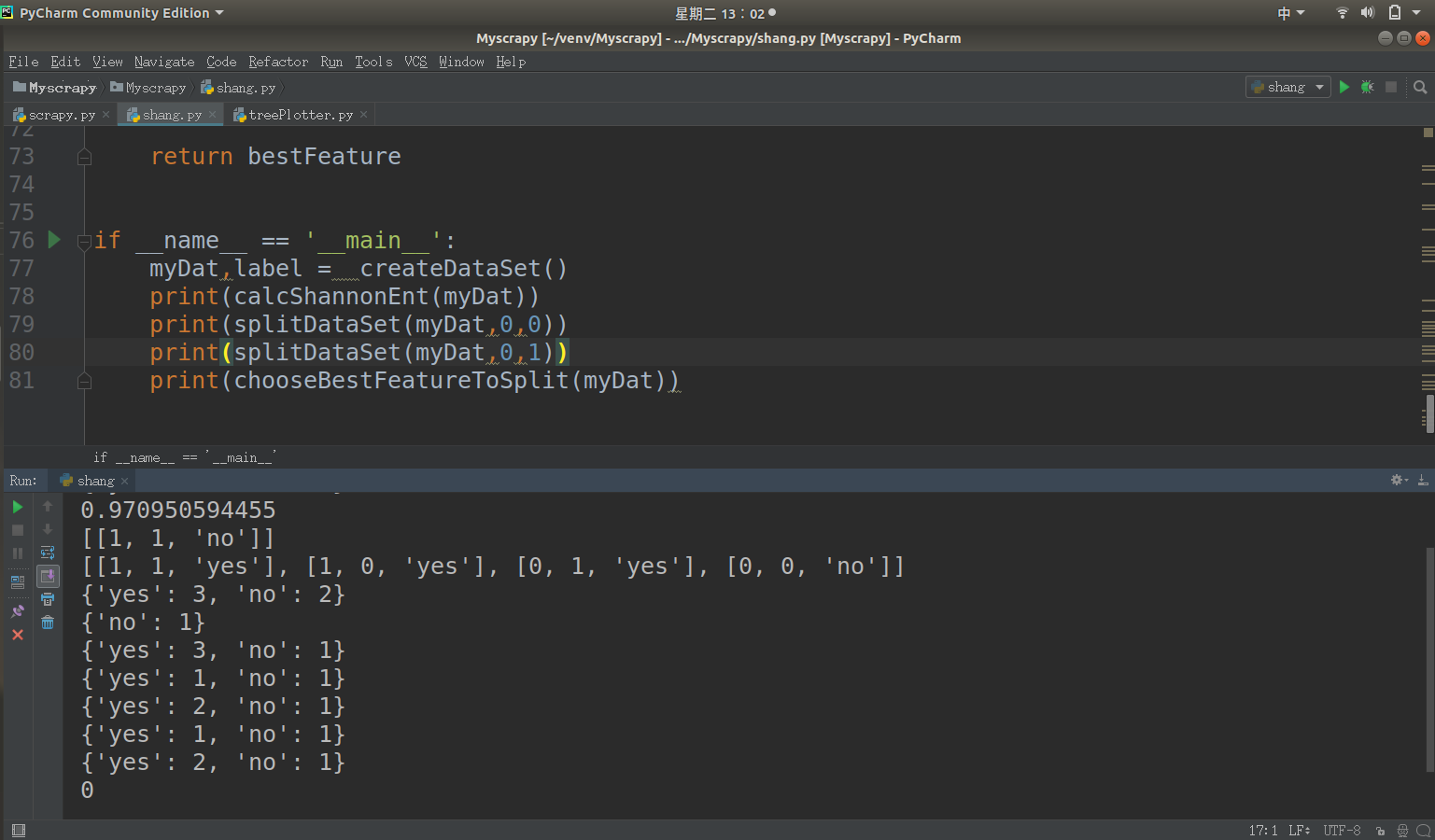
1 def createDataSet():
 2     dataSet = [[1,1,1,'yes'],
 3               [1,1,0,'yes'],
 4               [1,0,1,'yes'],
 5               [1,0,0,'no'],
 6               [0,1,1,'no']] # 我们定义了一个list来表示我们的数据集,这里的数据对应的是上表中的数据
 7
 8     labels = ['no surfacing','flippers']
 9
10     return dataSet, labels
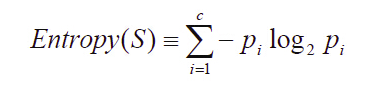
以信息增益度量属性选择,选择分裂后信息增益最大的属性进行分裂。信息熵是用来衡量一个随机变量出现的期望值。如果信息的不确定性越大,熵的值也就越大,出现的各种情况也就越多。
信息增益(information gain)是指信息划分前后的熵的变化,也就是说由于使用这个属性分割样例而导致的期望熵降低。也就是说,信息增益就是原有信息熵与属性划分后信息熵(需要对划分后的信息熵取期望值)的差值,具体计算法如下:
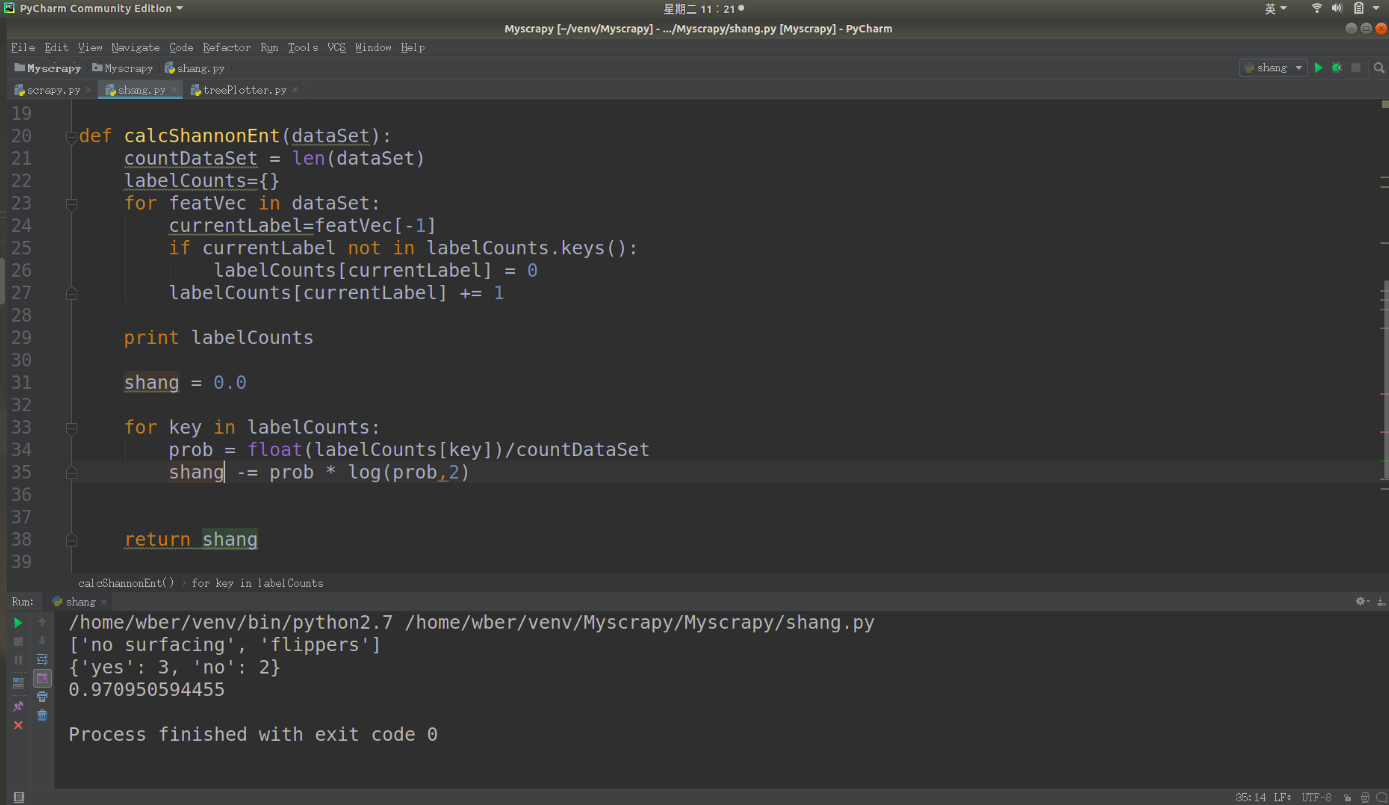
 1 from math import log
 2
 3 def calcShannonEnt(dataSet):#传入数据集
 4 # 在这里dataSet是一个链表形式的的数据集
 5     countDataSet = len(dataSet)
 6     labelCounts={} # 构建字典,用键值对的关系我们表示出 我们数据集中的类别还有对应的关系
 7     for featVec in dataSet: 通过for循环,我们每次取出一个数据集,如featVec=[1,1,'yes']
 8         currentLabel=featVec[-1] # 取出最后一列 也就是类别的那一类,比如说‘yes’或者是‘no’
 9         if currentLabel not in labelCounts.keys():
10             labelCounts[currentLabel] = 0
11         labelCounts[currentLabel] += 1
12
13     print labelCounts
14
15     shang = 0.0
16
17     for key in labelCounts:
18         prob = float(labelCounts[key])/countDataSet
19         shang -= prob * log(prob,2)
20     return shang
1     dataSet = [[1, 1, 1, 'yes'],
2                [1, 1, 0, 'yes'],
3                [1, 0, 1, 'yes'],
4                [1, 0, 0, 'no'],
5                [0, 1, 1, 'no']]
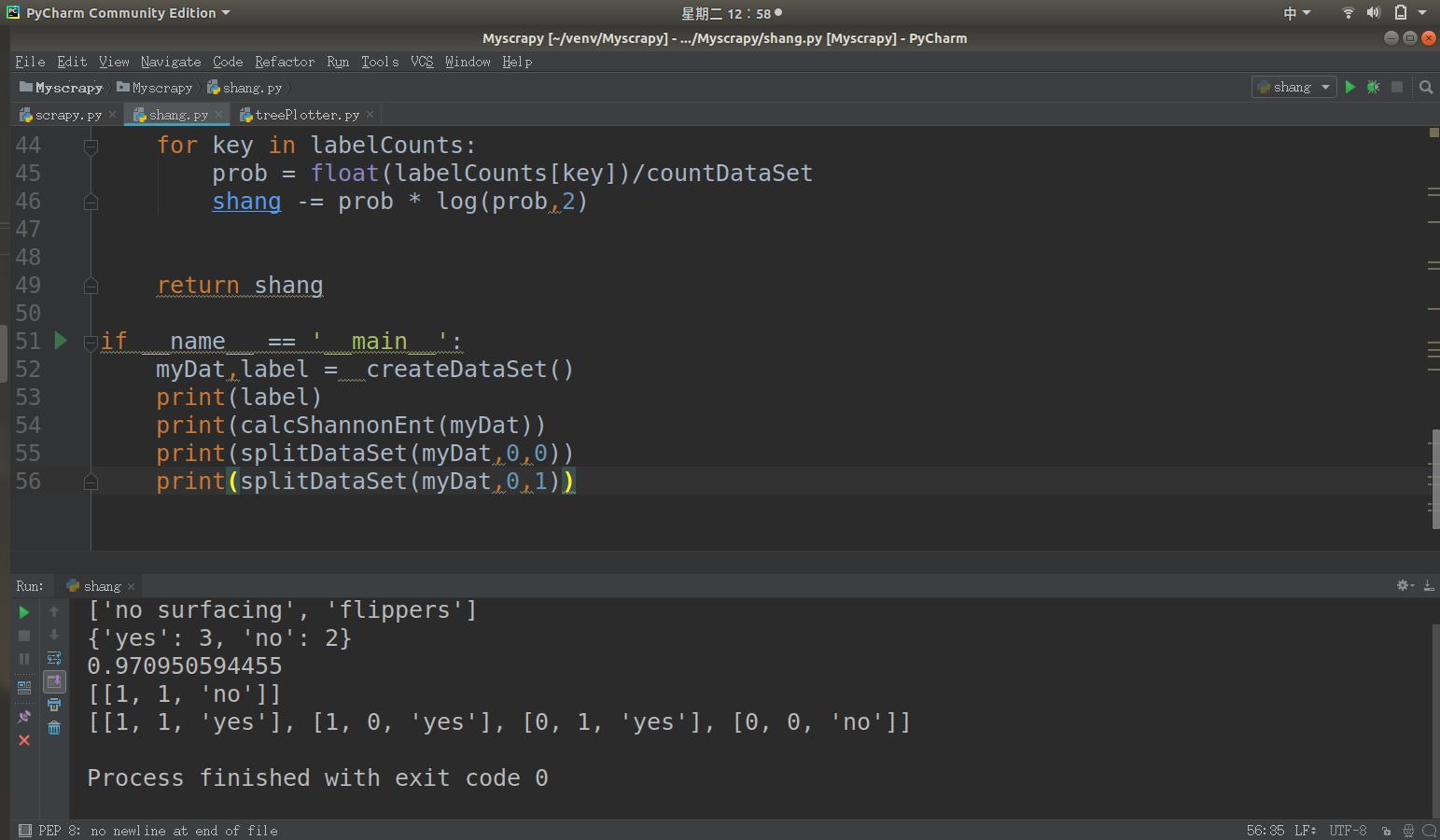
 1 def splitDataSet(dataSet,axis,value):
 2     retDataSet = []
 3
 4     for featVec in dataSet:
 5         if featVec[axis] == value:
 6             reduceFeatVec = featVec[:axis]
 7             reduceFeatVec.extend(featVec[axis+1:])
 8             retDataSet.append(reduceFeatVec)
 9
10     return retDataSet
 1 def chooseBestFeatureToSplit(dataSet):
 2     numFeatures = len(dataSet[0])-1
 3     baseEntropy = calcShannonEnt(dataSet)
 4     bestInfoGain =0.0
 5     bestFeature = -1
 6     for i in range(numFeatures):
 7         featList = [sample[i] for sample in dataSet]
 8         uniqueVals = set(featList)
 9         newEntropy = 0.0
10         for value in uniqueVals:
11             subDataSet = splitDataSet(dataSet,i,value)
12             prob = len(subDataSet)/float(len(dataSet))
13             newEntropy += prob * calcShannonEnt(subDataSet)
14         infoGain = baseEntropy - newEntropy
15         if(infoGain > bestInfoGain):
16             bestInfoGain = infoGain
17             bestFeature = i
18
19     return bestFeature
将数据集随机地切分为S个互不相交的大小相同的子集
然后挑选其中S-1个子集作为训练集,训练模型,用剩下的一个子集作测试集,获得测试误差或者评测指标
将上面过程对所有可能的S种选择重复进行,即每次都是用不同的测试集
最后对S次实验所得的数据(测试误差或者评测指标)取均值。
![]()
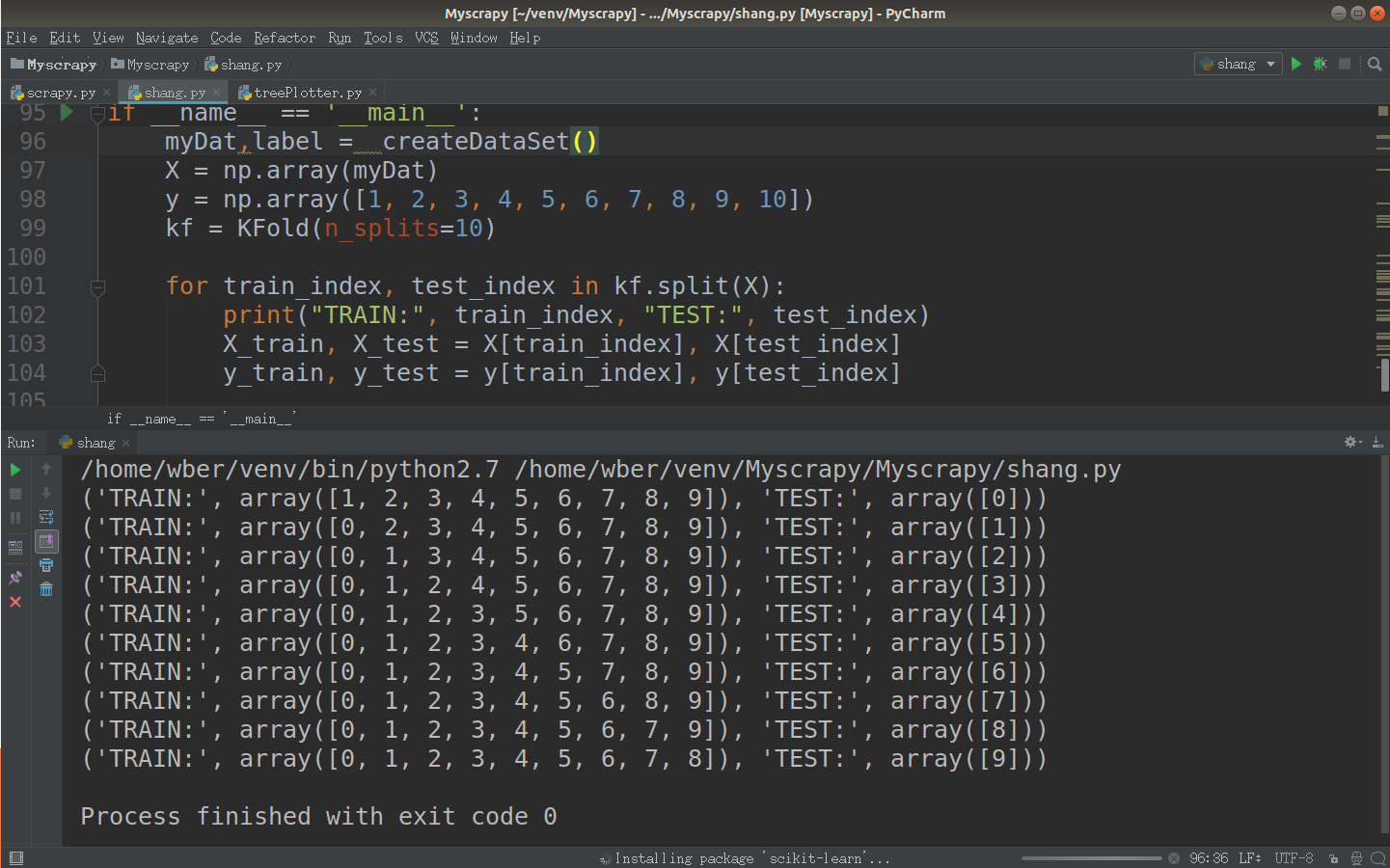
代码如下:
1      X = np.array(myDat)
2      y = np.array([1, 2, 3, 4, 5, 6, 7, 8, 9, 10])
3      kf = KFold(n_splits=10)
4
5      for train_index, test_index in kf.split(X):
6          print("TRAIN:", train_index, "TEST:", test_index)
7          X_train, X_test = X[train_index], X[test_index]
8          y_train, y_test = y[train_index], y[test_index]
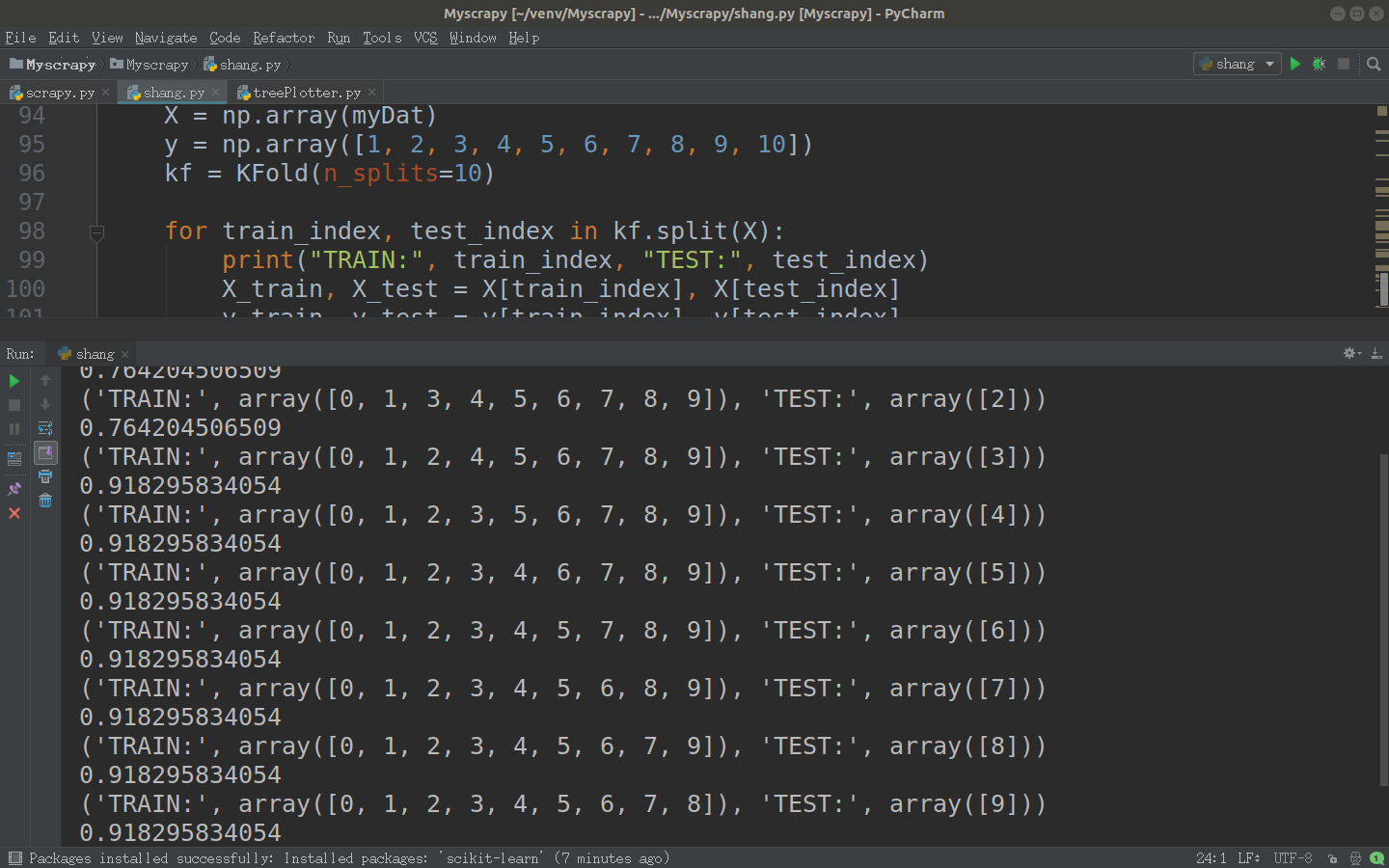
测试:
![]()
完整代码:
 1 # -*- coding: utf-8 -*-
 2 import csv
 3
 4 from bs4 import BeautifulSoup
 5 import requests
 6 import mycsv
 7 import sys
 8
 9 reload(sys)
10 sys.setdefaultencoding('utf-8')
11
12 # 请求头设置
13 header = {
14     'Accept': '*/*;',
15     'Connection': 'keep-alive',
16     'Accept-Language': 'zh-CN,zh;q=0.9',
17     'Accept-Encoding': 'gzip, deflate, br',
18     'Host': 'book.douban.com',
19     'User-Agent': 'Mozilla/5.0 (X11; Linux x86_64) AppleWebKit/537.36 (KHTML, like Gecko) Chrome/67.0.3396.87 Safari/537.36'
20 }
21
22
23 # 初始化csv文件
24 def info(name):
25     csvinfo = open(name + '.mycsv', 'ab')
26     begcsv = csv.writer(csvinfo)
27     begcsv.writerow(['titles', 'authors', 'nums', 'peoples'])
28     csvinfo.close()
29
30
31 # 爬取指定name模块的url,并存储至name.csv文件
32 def web(url, name):
33     db_data = requests.get(url, headers=header)
34     soup = BeautifulSoup(db_data.text, 'lxml')
35     titles = soup.select('#subject_list > ul > li > div.info > h2 > a')
36     authors = soup.select('#subject_list > ul > li > div.info > div.pub')
37     nums = soup.select('#subject_list > ul > li > div.info > div.star.clearfix > span.rating_nums')
38     peoples = soup.select('#subject_list > ul > li > div.info > div.star.clearfix > span.pl')
39     print(titles[0])
40     for title, author, num, people in zip(titles, authors, nums, peoples):
41         data = [
42             (
43                 title.get('title'),
44                 author.get_text().replace(' ', '').replace("\n", ""),
45                 num.get_text().replace(' ', '').replace("\n", ""),
46                 people.get_text().replace(' ', '').replace("\n", "")
47             )
48         ]
49         csvfile = open(name + '.mycsv', 'ab')
50         writer = csv.writer(csvfile)
51         print(data)
52         writer.writerows(data)
53         csvfile.close()
54
55
56 # name模块标签分页  指定为前50页
57 def setCsv(name):
58     url = 'https://book.douban.com/tag/' + name
59     urls = [('https://book.douban.com/tag/' + name + '?start={}&type=T').format(str(i)) for i in range(20, 980, 20)]
60     info(name=name)
61     web(url, name)
62     for single_url in urls:
63         print(single_url)
64         web(single_url, name=name)
65
66
67 if __name__ == '__main__':
68     setCsv(str)  #str为标签名
69
70
71
 1 # coding=utf-8
 2 import matplotlib.pyplot as plt
 3
 4 decisionNode = dict(boxstyle='sawtooth', fc='10')
 5 leafNode = dict(boxstyle='round4',fc='0.8')
 6 arrow_args = dict(arrowstyle='<-')
 7
 8
 9
10 def plotNode(nodeTxt, centerPt, parentPt, nodeType):
11     createPlot.ax1.annotate(nodeTxt, xy=parentPt, xycoords='axes fraction',\
12                              xytext=centerPt,textcoords='axes fraction',\
13                              va='center', ha='center',bbox=nodeType,arrowprops\
14                              =arrow_args)
15
16
17 def getNumLeafs(myTree):
18     numLeafs = 0
19     firstStr = list(myTree.keys())[0]
20     secondDict = myTree[firstStr]
21     for key in secondDict:
22         if(type(secondDict[key]).__name__ == 'dict'):
23             numLeafs += getNumLeafs(secondDict[key])
24         else:
25             numLeafs += 1
26     return  numLeafs
27
28 def getTreeDepth(myTree):
29     maxDepth = 0
30     firstStr = list(myTree.keys())[0]
31     secondDict = myTree[firstStr]
32     for key in secondDict:
33         if(type(secondDict[key]).__name__ == 'dict'):
34             thisDepth = 1+getTreeDepth((secondDict[key]))
35         else:
36             thisDepth = 1
37         if thisDepth > maxDepth: maxDepth = thisDepth
38     return maxDepth
39
40 def retrieveTree(i):
41     #预先设置树的信息
42     listOfTree = [{'no surfacing':{0:'no',1:{'flipper':{0:'no',1:'yes'}}}},
43         {'no surfacing':{0:'no',1:{'flipper':{0:{'head':{0:'no',1:'yes'}},1:'no'}}}},
44         {'Comment score greater than 8.0':{0:{'Comment score greater than 9.5':{0:'Yes',1:{'More than 45,000 people commented': {
45         0: 'Yes',1: 'No'}}}},1:'No'}}]
46     return listOfTree[i]
47
48 def createPlot(inTree):
49     fig = plt.figure(1,facecolor='white')
50     fig.clf()
51     axprops = dict(xticks = [], yticks=[])
52     createPlot.ax1 = plt.subplot(111,frameon = False,**axprops)
53     plotTree.totalW = float(getNumLeafs(inTree))
54     plotTree.totalD = float(getTreeDepth(inTree))
55     plotTree.xOff = -0.5/plotTree.totalW;plotTree.yOff = 1.0
56     plotTree(inTree,(0.5,1.0), '')
57     plt.title('Douban reading Decision Tree\n')
58     plt.show()
59
60 def plotMidText(cntrPt, parentPt,txtString):
61     xMid = (parentPt[0]-cntrPt[0])/2.0 + cntrPt[0]
62     yMid = (parentPt[1] - cntrPt[1])/2.0 + cntrPt[1]
63     createPlot.ax1.text(xMid, yMid, txtString)
64
65 def plotTree(myTree, parentPt, nodeTxt):
66     numLeafs = getNumLeafs(myTree)
67     depth = getTreeDepth(myTree)
68     firstStr = list(myTree.keys())[0]
69     cntrPt = (plotTree.xOff+(1.0+float(numLeafs))/2.0/plotTree.totalW,\
70               plotTree.yOff)
71     plotMidText(cntrPt,parentPt,nodeTxt)
72     plotNode(firstStr,cntrPt,parentPt,decisionNode)
73     secondDict = myTree[firstStr]
74     plotTree.yOff = plotTree.yOff - 1.0/plotTree.totalD
75     for key in secondDict:
76         if type(secondDict[key]).__name__ == 'dict':
77             plotTree(secondDict[key],cntrPt,str(key))
78         else:
79             plotTree.xOff = plotTree.xOff + 1.0/plotTree.totalW
80             plotNode(secondDict[key],(plotTree.xOff,plotTree.yOff),\
81                      cntrPt,leafNode)
82             plotMidText((plotTree.xOff,plotTree.yOff),cntrPt,str(key))
83     plotTree.yOff = plotTree.yOff + 1.0/plotTree.totalD
84
85 if __name__ == '__main__':
86     myTree = retrieveTree(2)
87     createPlot(myTree)
  1 # coding=utf-8
  2 import random
  3 from math import log
  4 from sklearn.model_selection import KFold
  5 import numpy as np
  6
  7 def splitDataSet(dataSet,axis,value):
  8     retDataSet = []
  9
 10     for featVec in dataSet:
 11         if featVec[axis] == value:
 12             reduceFeatVec = featVec[:axis]
 13             reduceFeatVec.extend(featVec[axis+1:])
 14             retDataSet.append(reduceFeatVec)
 15
 16     return retDataSet
 17
 18
 19 def createDataSet():
 20     dataSet = [[1, 1, 1, 'yes'],
 21                [1, 1, 0, 'yes'],
 22                [1, 0, 1, 'yes'],
 23                [1, 0, 0, 'no'],
 24                [0, 1, 1, 'no'],
 25                [0, 0, 0, 'no'],
 26                [0, 0, 1, 'no'],
 27                [0, 1, 0, 'no'],
 28                [0, 0, 0, 'no'],
 29                [0, 1, 1, 'no']
 30
 31                ]
 32
 33     labels = ['no surfacing','flippers']
 34
 35     return dataSet, labels
 36
 37
 38 def calcShannonEnt(dataSet):
 39     countDataSet = len(dataSet)
 40     labelCounts={}
 41     for featVec in dataSet:
 42         currentLabel=featVec[-1]
 43         if currentLabel not in labelCounts.keys():
 44             labelCounts[currentLabel] = 0
 45         labelCounts[currentLabel] += 1
 46     shang = 0.0
 47
 48     for key in labelCounts:
 49         prob = float(labelCounts[key])/countDataSet
 50         shang -= prob * log(prob,2)
 51
 52
 53     return shang
 54
 55
 56 def chooseBestFeatureToSplit(dataSet):
 57     numFeatures = len(dataSet[0])-1
 58     baseEntropy = calcShannonEnt(dataSet)
 59     bestInfoGain =0.0
 60     bestFeature = -1
 61
 62     for i in range(numFeatures):
 63         featList = [sample[i] for sample in dataSet]
 64         uniqueVals = set(featList)
 65         newEntropy = 0.0
 66         for value in uniqueVals:
 67             subDataSet = splitDataSet(dataSet,i,value)
 68             prob = len(subDataSet)/float(len(dataSet))
 69             newEntropy += prob * calcShannonEnt(subDataSet)
 70
 71         infoGain = baseEntropy - newEntropy
 72
 73         if(infoGain > bestInfoGain):
 74             bestInfoGain = infoGain
 75             bestFeature = i
 76
 77     return bestFeature
 78
 79
 80 def SplitData(dataSet, k, seed):
 81     testSet = []
 82     trainSet = []
 83     random.seed(seed)
 84     for user, item in dataSet:
 85         if random.randint(0,10) == k:
 86             testSet.append([user,item])
 87         else:
 88             trainSet.append([user,item])
 89     return testSet, trainSet
 90
 91
 92 if __name__ == '__main__':
 93     myDat,label =  createDataSet()
 94     X = np.array(myDat)
 95     y = np.array([1, 2, 3, 4, 5, 6, 7, 8, 9, 10])
 96     kf = KFold(n_splits=10)
 97
 98     for train_index, test_index in kf.split(X):
 99         print("TRAIN:", train_index, "TEST:", test_index)
100         X_train, X_test = X[train_index], X[test_index]
101         y_train, y_test = y[train_index], y[test_index]
102         print(calcShannonEnt(X[train_index]))