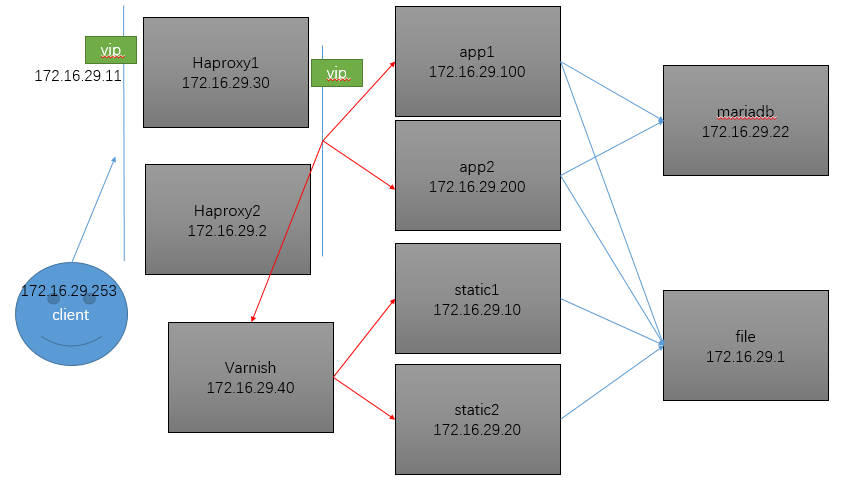
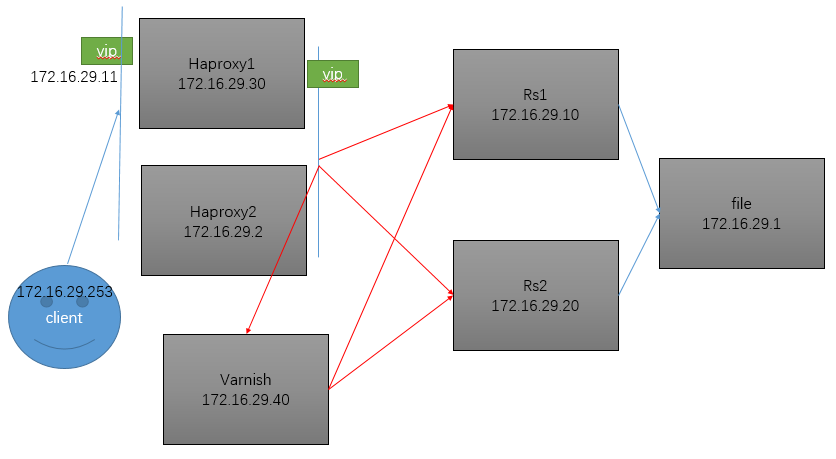
这里使用haproxy构建一个动静分离的集群,并且静态数据请求使用varnish做缓存。本打算做图1.1的集群,但是手头机器不够,只好委曲求全把动态服务器和静态服务器和到一起(主要是懒),数据库和共享文件和到一起如图1.2

图1.1

图1.2
file服务器的配置
#安装mysqld和nfs服务器
yum install mysql-server nfs-utils -y
#提供网页文件
mkdir /wordpress
wget http://download.comsenz.com/DiscuzX/3.2/Discuz_X3.2_SC_UTF8.zip
unzip Discuz_X3.2_SC_UTF8.zip -d /wordpress
chown -R apache:apache /wordpress
cat > /etc/exports <<eof
/wordpress 172.16.0.0/16(rw,no_root_squash)
eof
service nfs start
#提供数据库
service mysqld start
mysql <<eof
grant all privileges on wpdb.* to wpuser@'172.16.29.%'identified by "wppass";
eof
Rs服务器的配置
yum install nfs-utils httpd php php-mysql -y
cat >> /etc/fstab <<eof
172.16.29.1:/wordpress /wordpress nfs defaults 0 0
eof
mkdir /wordpress
mount -a
#以下是提供httpd配置文件
vim /etc/httpd/conf/httpd.conf
#把DocumentRoot "/var/www/html"改成如下
DocumentRoot "/wordpress/upload"
#把<Directory "/var/www/html">改为如下内容
<Directory "/wordpress">
#把DirectoryIndex index.html改成如下内容
DirectoryIndex index.php index.html
#启动服务
systemctl start httpd.service
varnish服务器的配置
yum install varnish -y
vim /etc/varnish/varnish.params
#把VARNISH_STORAGE="file,/var/lib/varnish/varnish_storage.bin,1G"改为如下内容,意思是使用512m的内存进行缓存数据
VARNISH_STORAGE="malloc,512m"
cat > /etc/varnish/default.vcl <<eof
#提供如下配置文件
vcl 4.0;
import directors;
backend default {
    .host = "127.0.0.1";
    .port = "8080";
}
#定义后端服务器状态检测机制
probe check {
    .url = "/robots.txt";
    .window = 5;
    .threshold = 3;
    .interval = 2s;
    .timeout = 1s;
}
#定义两个服务器
backend server1 {
    .host = "172.16.29.10";
    .port = "80";
    .probe = check;
}
backend server2 {
    .host = "172.16.29.20";
    .port = "80";
    .probe = check;
}
#定义两个服务器的调度算法
sub vcl_init {
    new static = directors.round_robin();
    static.add_backend(server1);
    static.add_backend(server2);
}
#定义命中
sub vcl_recv {
    set req.backend_hint = static.backend();
}
sub vcl_backend_response {
}
sub vcl_deliver {
}
eof
haproxy服务器通用配置配置
两个haproxy服务器的keepalived的配置文件有细微的差别,注意注释信息
yum install haproxy keepalived -y
cat > /etc/haproxy/haproxy.cfg <<eof
global
    log         127.0.0.1 local2
    chroot      /var/lib/haproxy
    pidfile     /var/run/haproxy.pid
    maxconn     4000
    user        haproxy
    group       haproxy
    daemon
    stats socket /var/lib/haproxy/stats
defaults
    mode                    http
    log                     global
    option                  httplog
    option                  dontlognull
    option http-server-close
    option forwardfor       except 127.0.0.0/8
    option                  redispatch
    retries                 3
    timeout http-request    10s
    timeout queue           1m
    timeout connect         10s
    timeout client          1m
    timeout server          1m
    timeout http-keep-alive 10s
    timeout check           10s
    maxconn                 3000
frontend  main *:80
#静态数据访问重定向到动态服务器,其他的动态服务器
    acl url_static       path_beg       -i /static /p_w_picpaths /javascript /stylesheets
    acl url_static       path_end       -i .jpg .gif .png .css .js
    use_backend static          if url_static
    default_backend             app
#状态页
listen admin_stats
    bind *:8080
    stats enable
    stats uri /haproxy11
    acl hastats src 172.16.0.0/16
    block unless hastats
#静态服务器
backend static
    balance     roundrobin
    server      static 172.16.29.40:6081 check
#动态服务器
backend app
    balance     source
    server  rs1 172.16.29.10:80 check
    server  rs2 172.16.29.20:80 check
eof
systemctl restart haproxy.service
cat > /etc/keepalived/keepalived.conf <<eof
#keepalived的配置文件
! Configuration File for keepalived
global_defs {
   notification_email {
        root@localhost
   }
   notification_email_from keepalived@localhost
   smtp_server 127.0.0.1
   smtp_connect_timeout 30
   router_id node1
   vrrp_mcast_group 224.0.29.29
#这个脚本是为了维护代理服务器Haproxy时使用的
   vrrp_script chk_down {
       script "[[ -f /etc/haproxy/down ]] && exit 1 || exit 0"
       interval 1
       weight  -20
   }
#这个脚本是为了检测代理服务器Haproxy的状态
   vrrp_script chk_haproxy {
       script "killall -0 haproxy && exit 0 || exit 1"
       interval 1
       weight -20
   }
}
vrrp_instance VI_1 {
#另一台主机的下一行改为MASTER
    state BACKUP
    interface eno16777736
    virtual_router_id 51
#另一台主机的下一行改为100
    priority 90
    advert_int 1
    authentication {
        auth_type PASS
        auth_pass oldking
    }
    virtual_ipaddress {
        172.16.29.11/16 dev eno16777736 label eno16777736:0
    }
    track_script {
        chk_down
        chk_haproxy
    }
}
eof
我这里haproxy介绍的不够详细,参考这个博客http://www.cnblogs.com/dkblog/archive/2012/03/13/2393321.html,或者官方文档