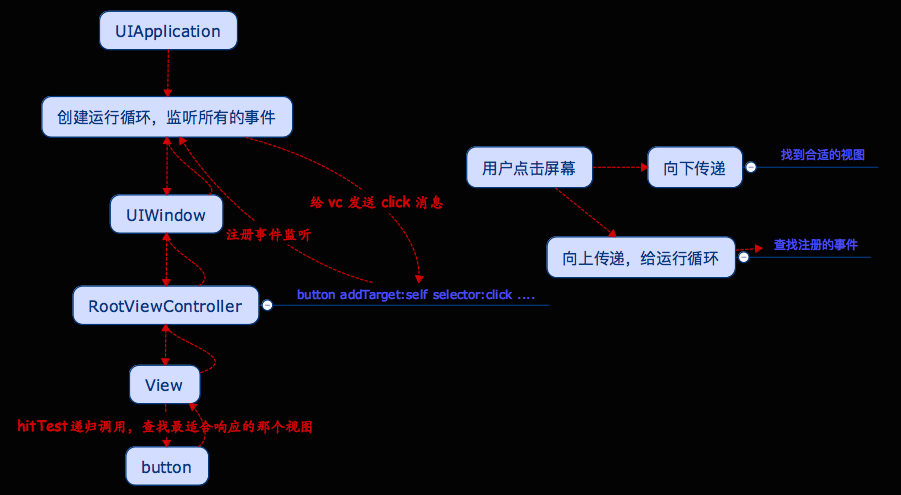
1、RunLoop
-
1)运行循环:
-
2)子线程运行循环:
-
3)响应者链条事件监听过程:
![RunLoop1]()
2、运行循环的使用
2.1 时钟调度
    /*
        - (void)addTimer:(NSTimer *)timer forMode:(NSString *)mode;

        NSDefaultRunLoopMode: 时钟,网络。           发生用户交互的时候,时钟会被暂停
        NSRunLoopCommonModes: 用户交互,响应级别高。   发生用户交互的时候,时钟仍然会触发,如果时钟触发方法非常耗时,
                                                   使用此方式时用户操作会造成非常严重的卡顿。
    */
-
以 NSRunLoopCommonModes 方式创建
    // 调度时钟
    self.timer = [NSTimer timerWithTimeInterval:1.0
                                         target:self
                                       selector:@selector(updateTimer)
                                       userInfo:nil
                                        repeats:YES];

    // 将时钟以 NSRunLoopCommonModes 模式添加到运行循环
    [[NSRunLoop currentRunLoop] addTimer:self.timer forMode:NSRunLoopCommonModes];
-
以 NSDefaultRunLoopMode 方式创建
    // 调度时钟
    /*
        默认将时钟以 NSDefaultRunLoopMode 模式添加到运行循环
    */
    self.timer = [NSTimer scheduledTimerWithTimeInterval:1.0
                                                  target:self
                                                selector:@selector(updateTimer)
                                                userInfo:nil
                                                 repeats:YES];
-
子线程运行循环
    dispatch_async(dispatch_get_global_queue(0, 0), ^{

        // 在子线程开启时钟,由于子线程的运行循环没有启动,所以没法监听时钟事件
        self.timer = [NSTimer timerWithTimeInterval:1.0
                                             target:self
                                           selector:@selector(updateTimer)
                                           userInfo:nil
                                            repeats:YES];

        [[NSRunLoop currentRunLoop] addTimer:self.timer forMode:NSDefaultRunLoopMode];

        // 启动子线程的运行循环,这句代码就是一个死循环!如果不停止运行循环,不会执行后续的任何代码
        CFRunLoopRun();

        // 停止子线程运行循环之前,不会执行添加到此处的任何代码
    });

    // 运行循环执行操作方法
    - (void)updateTimer {

        static int num = 0;

        NSLog(@"%d %@", num++, [NSThread currentThread]);

        // 满足条件后,停止当前的运行循环
        if (num == 8) {

            // 一旦停止了运行循环,后续代码能够执行,执行完毕后,线程被自动销毁
            CFRunLoopStop(CFRunLoopGetCurrent());
        }
    }