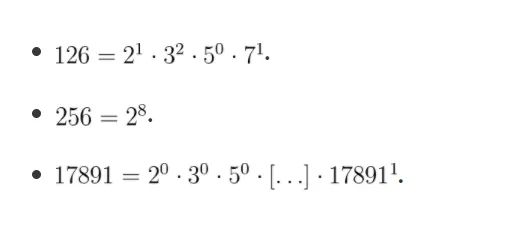
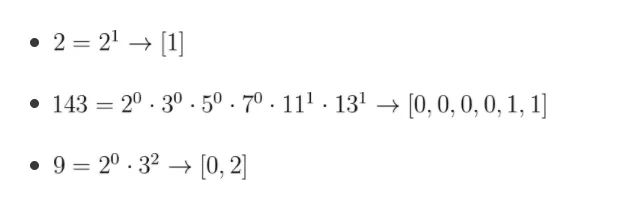
我可能很快会写一篇完整的关于生成质数的算法的文章,因为这是一个很酷的话题,本身也是一个古老的研究领域。最广为人知的算法是爱拉托逊斯筛法(Sieve of Erathosthenes ),但这只是冰山一角。[注6]
在这里,一个非常幼稚的实现就够了:
defprimes(starting: int = 2): """Yield the primes in order.
Args: starting: sets the minimum number to consider.
Note: `starting` can be used to get all prime numbers _larger_ than some number. By default it doesn't skip any candidate primes. """ candidate_prime = starting whileTrue: candidate_factor = 2 is_prime = True # We'll try all the numbers between 2 and # candidate_prime / 2. If any of them divide # our candidate_prime, then it's not a prime! while candidate_factor <= candidate_prime // 2: if candidate_prime % candidate_factor == 0: is_prime = False break candidate_factor += 1 if is_prime: yield candidate_prime candidate_prime += 1
创建空列表
defempty_list() -> int: """Create a new empty list.""" # 1 is the empty list. It isn't divisible by any prime. return1
遍历元素
defiter_list(l: int): """Yields elements in the list, from first to last.""" # We go through each prime in order. The next value of # the list is equal to the number of times the list is # divisible by the prime. for p in primes(): # We decided we will have no trailing 0s, so when # the list is 1, it's over. if l <= 1: break # Count the number of divisions until the list is # not divisible by the prime number. num_divisions = 0 while l % p == 0: num_divisions += 1 l = l // p # could be / as well yield num_divisions
访问元素
defaccess(l: int, i: int) -> int: """Return i-th element of l.""" # First we iterate over all primes until we get to the # ith prime. j = 0 for p in primes(): if j == i: ith_prime = p break j += 1 # Now we divide the list by the ith-prime until we # cant divide it no more. num_divisions = 0 while l % ith_prime == 0: num_divisions += 1 l = l // ith_prime return num_divisions
添加元素
defappend(l: int, elem: int) -> int: # The first step is finding the largest prime factor. # We look at all primes until l. # The next prime after the last prime factor is going # to be the base we need to use to append. # E.g. if the list if 18 -> 2**1 * 3**2 -> [1, 2] # then the largest prime factor is 3, and we will # multiply by the _next_ prime factor to some power to # append to the list. last_prime_factor = 1# Just a placeholder for p in primes(): if p > l: break if l % p == 0: last_prime_factor = p # Now get the _next_ prime after the last in the list. for p in primes(starting=last_prime_factor + 1): next_prime = p break # Now finally we append an item by multiplying the list # by the next prime to the `elem` power. return l * next_prime ** elem
我们可以将列表的长度存储在单独的 int 中,据此知道要在列表末尾考虑多少个 0。(猫注:还有几句话没看懂,不译)If we don’t want to have a whole separateint, we can always write the length of the list as the exponent of 2 and start the actual list with the exponent of 3. This has some redundant information, though. The way to avoid redundant information is to store the number of final 0s in the list, instead of the entire length. We won’t be worrying about any of this, though.
另请参见《 The Genuine Sieve of Erathosthenes》论文,它澄清了这一算法是如何被定义的。
Python猫注: 以上是全部译文,但我最后还想补充一个有趣的内容。在《黑客与画家》中,保罗·格雷大师有一个惊人的预言,他认为在逻辑上不需要有整数类型,因为整数 n 可以用一个 n 元素的列表来表示。哈哈,这跟上文的脑洞恰好反过来了!想象一下,一个只有整数类型没有列表的编程语言,以及一个只有列表类型没有整数的编程语言,哪一个更有可能在未来出现呢?
Rocky Linux(中文名:洛基)是由Gregory Kurtzer于2020年12月发起的企业级Linux发行版,作为CentOS稳定版停止维护后与RHEL(Red Hat Enterprise Linux)完全兼容的开源替代方案,由社区拥有并管理,支持x86_64、aarch64等架构。其通过重新编译RHEL源代码提供长期稳定性,采用模块化包装和SELinux安全架构,默认包含GNOME桌面环境及XFS文件系统,支持十年生命周期更新。
Sublime Text
Sublime Text具有漂亮的用户界面和强大的功能,例如代码缩略图,Python的插件,代码段等。还可自定义键绑定,菜单和工具栏。Sublime Text 的主要功能包括:拼写检查,书签,完整的 Python API , Goto 功能,即时项目切换,多选择,多窗口等等。Sublime Text 是一个跨平台的编辑器,同时支持Windows、Linux、Mac OS X等操作系统。